
Sand Blasting Hose Supplier in Saudi Arabia
خرطوم ساند بلاست · خرطوم سفع رملي
Six bores from 1/2″ to 2″ (12.00 to 50.00 mm), all rated 175 PSI / 12 BAR working and 700 PSI / 48 BAR minimum burst. Filler-free rubber lining, high-tenacity synthetic yarn braid, and a copper element that reduces static build-up. Standard coil 40 m. Made at our own works in Bhiwadi, Rajasthan, and shipped from Nhava Sheva (JNPT) and Mundra to Jeddah, Dammam, Jubail and Yanbu.
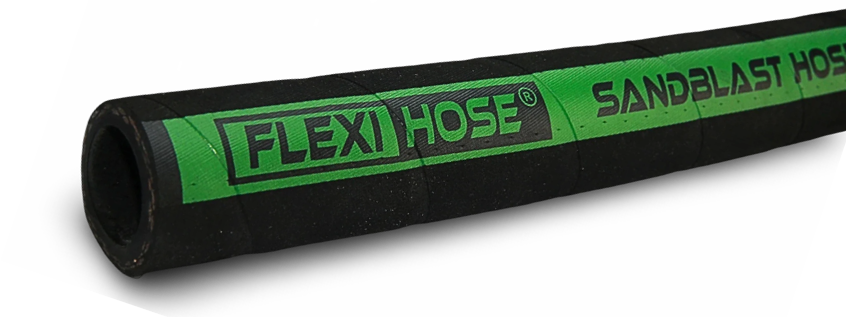
Sand blasting hose for Saudi Arabia: the short answer
A sand blasting hose carries abrasive and compressed air from the blast pot to the nozzle. Four things decide whether it is the right one for a Saudi job.
- Size the bore from the nozzle. Take a hose bore three to four times the nozzle orifice. A 3/8″ (10 mm) nozzle runs on 1-1/4″ to 1-1/2″ (31 to 38 mm) hose.
- Check the rating against the pot. This hose works at 175 PSI / 12 BAR in every bore, with a 700 PSI / 48 BAR minimum burst.
- Control static. A copper element built into this hose reduces static build-up. Bond and earth the pot, hose, nozzle and workpiece as your site requires.
- Leave silica sand out of Aramco work. Saudi Aramco prohibits silica sand for abrasive blasting at all its facilities and projects (GI 0006.021 §8.1). The hose carries sand, steel shot, grit or garnet.
The same hose, under many names
Buyers in the Kingdom ask for one product by all of these names: an abrasion-resistant rubber hose that carries sand, steel shot, grit or garnet from a blast pot to the nozzle.
- Sand blasting hose
- Sandblast hose
- Sand blast hose
- Abrasive blasting hose
- Blast hose
- Grit blasting hose
- Shot blasting hose
- Sand blasting hose pipe
- خرطوم ساند بلاست
- خرطوم سفع رملي
Specification table
Every figure is transcribed from the FLEXI HOSE Product Catalogue 2026-2027. PSI and BAR are the catalogue's own printed pairs and are not converted. The Order as column puts bore and mean outside diameter side by side, the way blast hose is usually ordered in Saudi Arabia. The coupling has to match the outside diameter.
| Bore (in) | Bore (mm) | Mean O.D. (mm) | Order as (mm) | WP (PSI) | WP (BAR) | Burst, min. (PSI) | Burst, min. (BAR) | Standard coil |
|---|---|---|---|---|---|---|---|---|
| 1/2″ | 12.00 | 27.00 | 12 × 27 | 175 | 12 | 700 | 48 | 40 m |
| 3/4″ | 20.00 | 33.00 | 20 × 33 | 175 | 12 | 700 | 48 | 40 m |
| 1″ | 25.00 | 39.00 | 25 × 39 | 175 | 12 | 700 | 48 | 40 m |
| 1-1/4″ | 31.00 | 48.00 | 31 × 48 | 175 | 12 | 700 | 48 | 40 m |
| 1-1/2″ | 38.00 | 54.00 | 38 × 54 | 175 | 12 | 700 | 48 | 40 m |
| 2″ | 50.00 | 70.00 | 50 × 70 | 175 | 12 | 700 | 48 | 40 m |
Reading the table
Pressure does not change with bore. Every size is 175 PSI / 12 BAR working and 700 PSI / 48 BAR minimum burst.
Order by bore × O.D. A 1-1/4″ hose is 31 × 48 mm. Your coupling is chosen from the 48.
Coils are 40 m. Cut lengths and made-up assemblies on request.
What size blast hose for your nozzle
Bore is chosen from the nozzle, not from what is on the shelf. Take a hose bore three to four times the nozzle orifice. An undersized hose starves the nozzle: pressure drops at the work face, the abrasive slows, and the hose wears faster. Pick your nozzle below to see where it lands on our six bores.
Pick a nozzle size to see the suggested bore. Sizes read as bore × mean O.D. in mm.
| Nozzle orifice | Suggested hose bore |
|---|---|
| 3/16″ (5 mm) | 3/4″ (20 mm) |
| 1/4″ (6 mm) | 3/4″ to 1″ (20 to 25 mm) |
| 5/16″ (8 mm) | 1″ to 1-1/4″ (25 to 31 mm) |
| 3/8″ (10 mm) | 1-1/4″ to 1-1/2″ (31 to 38 mm) |
| 1/2″ (12 mm) | 1-1/2″ to 2″ (38 to 50 mm) |
If the compressor cannot hold the nozzle's air demand at working pressure, a larger hose will not rescue it. For the full chain from nozzle to compressor, see our nozzle size and CFM chart.
Blasting on Saudi Aramco sites
Saudi Aramco's General Instruction 0006.021, Safety Requirements for Abrasive Blast Cleaning, sets four rules that reach the hose. Contractors on Aramco facilities and projects work to it. Here is each rule and how a Flexihose order meets it.
- GI 0006.021 §8.1
No silica sand
Silica sand for abrasive blasting is prohibited at all Saudi Aramco facilities and on all Aramco projects and construction sites.
The hose carries sand, steel shot, grit or garnet. Its extra-thick, filler-free lining is built for abrasion, not for one media.
- GI 0006.021 §6.1
Bond and earth the line
Nozzle, hose, blasting equipment and workpiece are bonded and earthed, with ground continuity of one megohm or less, checked before each job and whenever equipment is moved.
This hose has a copper element that reduces static build-up. Make the bond through the couplings and test continuity on site, as the instruction requires. We do not publish a resistance value for the hose.
- GI 0006.021 §6.2
Fittings secured
Hose and nozzle fittings are fixed so they cannot come apart during blasting.
We supply made-up assemblies with couplings matched to the mean outside diameter of each bore.
- GI 0006.021 §6.3
Deadman control
Blasting stops automatically when the operator lets go of the control.
A deadman is safety equipment, not hose. We do not supply it. Specify it with the line.
Clauses are quoted from the 25 April 2007 issue of GI 0006.021. Check the revision your contract names. We do not claim Aramco approval for this hose. If your contract lists approved manufacturers, send us the material code and we will answer plainly.
How it is built
A blast hose wears from the inside out, so the lining does the work. The wall is built to survive abrasive moving at speed, not to hold high pressure.
Lining
Extra-thick seamless rubber, free from mineral filler. Filler is what gives the abrasive something to tear out of a cheap lining. DIN abrasion loss is < 60 mm³.
Reinforcement
Single/double high-tenacity synthetic yarn braids. Textile rather than wire keeps the hose flexible enough to drag around a job.
Cover and copper element
Rubber cover highly resistant to abrasion, ozone and weather, for a hose that lives outdoors. A copper element built into the hose reduces static build-up.
- 1Tubeextra-thick seamless rubber lining, free from mineral filler
- 2Reinforcementsingle/double high-tenacity synthetic yarn braids
- 3Coverrubber compound highly resistant to abrasion, ozone and weather
- CuCopper elementbuilt into the hose to reduce static build-up. Position in the wall not drawn
What this hose is not for
The wrong hose in a blast line is an injury, not an inconvenience. If your duty is on this list, say so and we will route you correctly or tell you we cannot help.
Not BIS licensed.
This grade exceeds IS 5894. It carries no CM/L number and is not called certified, compliant or conforming.
Not rated above 175 PSI / 12 BAR.
Working pressure is the same in every bore. It does not rise with a smaller bore.
Not rated above +75 C or below −40 C.
Outside that band, ask us before ordering. This is a wear part, not a hot-service hose.
Not for high-pressure water jetting.
This is a dry and wet abrasive media hose. Hydro-blasting and water-jetting duty needs a different construction.
Not a steam, air or chemical hose.
The lining is built for abrasion, not for heat, oil or chemical attack.
Not the 10 BAR textile-ply blast hose.
We make a second blast hose on a different construction and duty. Its figures do not apply here.
Where sand blasting hose is used in Saudi Arabia
Blast hose is a consumable. It wears out on every shutdown, pipeline spread and hull, and most of that work sits on the Gulf coast around Jubail and Dammam and on the Red Sea around Jeddah and Yanbu.
Petrochemical shutdowns
Tank, vessel and structural steel blasting during turnarounds on the integrated complexes at Jubail and Yanbu.
Ship repair and ports
Hull de-rusting before coating at the Gulf yards around Ras Al-Khair and Dammam, and at the Red Sea ports.
Pipelines
External coating preparation and field-joint blasting on pipeline spreads.
Construction programmes
Structural steel, stone and concrete surface preparation on the Kingdom's large construction projects.
Steel fabrication
Mill scale and weld spatter removal before painting, in the fabrication shops of Dammam and Riyadh.
Blasting contractors
Replacement hose for blast pots, supplied in 40 m coils or made up with couplings.
Shipping to Saudi Arabia
We ship from Nhava Sheva (JNPT) and Mundra on FOB, CIF and CFR terms. Transit is from sailing, not from order. Production time is added and confirmed on the quotation.
- Jeddah Islamic Port7 to 9 days
- King Abdulaziz Port, Dammam7 to 10 days
- Jubail Commercial Port8 to 10 days
- Yanbu Commercial Port8 to 10 days
- Riyadh, via Dammam9 to 12 days
- NEOM and Tabuk10 to 14 days
The company's own confirmed ranges, subject to sailing schedule and customs clearance.
Documents and conformity
Every consignment carries this document set.
- Commercial invoice
- Packing list
- Certificate of origin
- Bill of lading
- Test certificates
What we do and do not certify
Saudi customs clearance runs through the Kingdom's electronic conformity platform, which requires a product certificate and a per-shipment certificate for regulated goods. That process sits with the importer of record, not with us. We supply the document set above and the batch test reports your certification body will ask to see. We hold no Saudi conformity certificate and do not represent otherwise.
For stockists and distributors in Saudi Arabia
Most blast hose in the Kingdom is bought from a local stockist. If you are one, this is what we supply:
- Six sizes as ID × OD, from 12 × 27 to 50 × 70 mm
- Standard 40 m coils, or assemblies made up to your coupling
- The specification table above, for your own catalogue
- The full export document set with every consignment
Getting a quotation for Saudi Arabia
Send the duty, not just the part number
Nozzle size, run length, abrasive, bore, quantity and coupling type.
Name the delivery port
Jeddah, Dammam, Jubail, Yanbu or the port you clear through. We quote FOB and CIF side by side so you can compare against a local stockist honestly.
Tell us the documents you need
Batch test certificates, a certificate of origin format, or reports your conformity body will ask for. Asking at quotation stage costs nothing; asking after dispatch does.
Guides for blasting crews and buyers
Questions about sand blasting hose for Saudi Arabia
What pressure is your sand blasting hose rated for?
175 PSI / 12 BAR working pressure and 700 PSI / 48 BAR minimum burst. The rating is the same in all six bores from 1/2″ to 2″. It does not rise when the bore gets smaller.
What size blast hose do I need for my nozzle?
Take a hose bore three to four times the nozzle orifice. A 3/8″ (10 mm) nozzle runs on 1-1/4″ to 1-1/2″ (31 to 38 mm) hose, and a 1/2″ (12 mm) nozzle on 1-1/2″ to 2″ (38 to 50 mm). The full table is in the sizing section. Check that your compressor can hold the nozzle's air demand before you size up.
What sizes do you make, as ID × OD?
Six sizes, bore × mean outside diameter in mm: 12 × 27, 20 × 33, 25 × 39, 31 × 48, 38 × 54, 50 × 70. The coupling is matched to the outside diameter, not the bore.
What length are the coils?
The standard coil is 40 m in every bore from 1/2″ to 2″. If your run needs a different cut length, say so in the enquiry and we will confirm what the works can supply.
Does the hose control static build-up?
Yes. A copper element built into this hose reduces static build-up along the line. Bond and earth the pot, the nozzle holder and the workpiece as well, the way any blast line should be set up. We do not publish a resistance value for the hose.
Can I use this hose on a Saudi Aramco site?
Aramco's blasting rules apply to the whole set-up, not only the hose. GI 0006.021 asks for the nozzle, hose, blasting equipment and workpiece to be bonded and earthed, fittings secured, and a deadman control. This hose has a copper element against static and we supply it made up with couplings. We do not claim Aramco approval for it. If your contract names approved manufacturers, send us the material code and we will answer plainly.
Is silica sand allowed for sand blasting in Saudi Arabia?
Not on Saudi Aramco work. GI 0006.021 prohibits silica sand for abrasive blasting at all Saudi Aramco facilities and on all Aramco projects and construction sites. Outside Aramco, follow your client's specification. The hose itself carries sand, steel shot, grit or garnet.
Which standard does it meet?
It exceeds IS 5894. It holds no BIS licence, so we do not call it certified, compliant or conforming.
What is the temperature range?
−40 C to +75 C. This is a wear part built for abrasion, not a hot-service hose.
Can you fit blast couplings before dispatch?
Yes. Tell us the bore, the run length and the coupling type you use and we supply the assembly made up. On a hose dragged across a deck or scaffold every shift, a factory-made assembly outlasts one made up in the field.
Do you supply the deadman control?
No. A deadman control is safety equipment, not hose, and we do not supply it. Specify it with the line.
How long does shipping to Saudi Arabia take?
From sailing: Jeddah 7 to 9 days, Dammam 7 to 10, Jubail 8 to 10, Yanbu 8 to 10, Riyadh via Dammam 9 to 12, NEOM and Tabuk 10 to 14. Subject to sailing schedule and customs clearance. Production time is added and confirmed on the quotation.
What documents come with the shipment?
Commercial invoice, packing list, certificate of origin, bill of lading and test certificates. Saudi conformity certification for regulated goods sits with the importer of record.
Do you supply stockists and distributors in Saudi Arabia?
Yes. We quote trade quantities in 40 m coils or made-up assemblies, with the specification table on this page for your own catalogue and the full export document set with every consignment.
What is the HS code for the shipment?
We do not publish one, because classification is the importer's declaration. Our export desk states the code we invoice under on the quotation so your broker can confirm it against the current Saudi tariff schedule.
Specifications on this page are transcribed from the FLEXI HOSE Product Catalogue 2026-2027. PSI and BAR are the catalogue's own printed pairs and are not converted. Coil length and the copper element are company-confirmed facts added after the catalogue was printed. Last reviewed 27 September 2026.