
PTFE Hose Supplier in Saudi Arabia — SS PTFE Teflon Hose in 15 Proven Sizes
A PTFE hose is a stainless braided hose with a PTFE liner, specified where the medium is chemically aggressive or the temperature is beyond rubber. FLEXI HOSE® PTFE hose is catalogued in 15 sizes from 3.5 mm to 50 mm, rated 3625 PSI / 250 BAR at 1/8 inch down to 435 PSI / 30 BAR at 2 inch, for −65 °C to +260 °C.
Shipping outside India? See our full FLEXI HOSE export capability — Incoterms, export documentation and port of dispatch.
What Is a PTFE Hose?
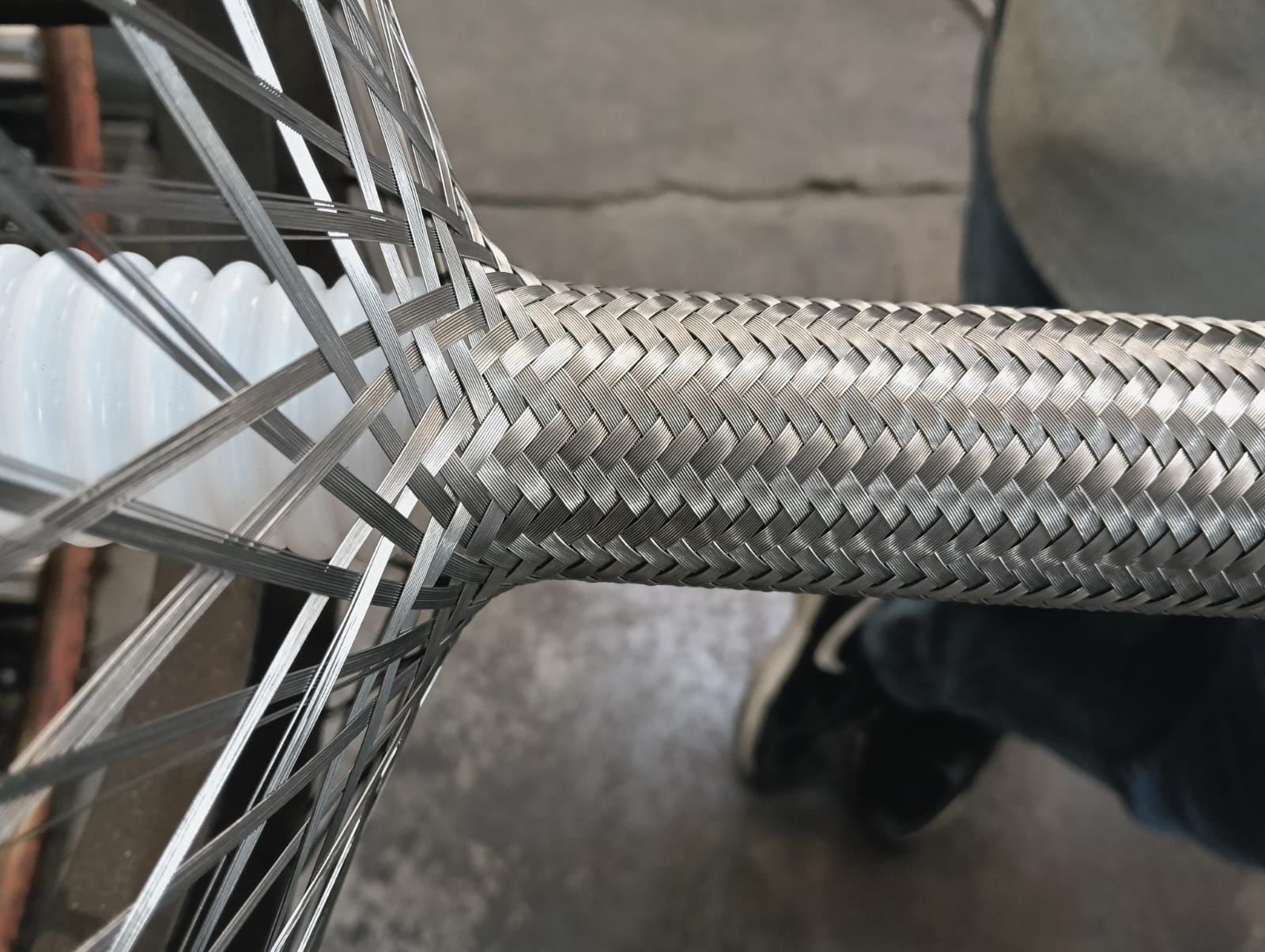
A PTFE hose — commonly called a Teflon hose after the original trade name — is a hose whose inner liner is polytetrafluoroethylene rather than rubber, overlaid with a stainless steel wire braid that carries the pressure. The liner is close to chemically inert and does not soften at temperatures that would destroy an elastomer, so the combination handles media and heat that no rubber hose will tolerate.
The FLEXI HOSE® product is catalogued for high temperature application on oil, steam, acid, diesel, petroleum, chemical, pharmaceutical and food industry duty. The service range is −65 °C to +260 °C — roughly 165 °C hotter at the top end than a two wire braid steam hose, and cold enough at the bottom to remain serviceable where rubber has gone brittle.
Pressure falls with size, as it does on any braided construction. The smallest PTFE hose at 3.5 mm bore is rated 3625 PSI / 250 BAR working, and the largest at 50 mm is rated 435 PSI / 30 BAR. Burst pressure is four times working pressure at every size. Where a metallic core is preferred to a lined one, the Saudi SS hose page covers the corrugated stainless range, and chemical suction duty at larger bores sits on the Saudi UHMWPE hose page.
On This Page
Jump straight to the PTFE hose information you need.
PTFE Hose in the FLEXI HOSE® Metallic and Chemical Range
Four grades cover the aggressive-media and high-temperature duties exported to Saudi Arabia. Every figure below is taken verbatim from the FLEXI HOSE® catalogue.
The PTFE hose grade covered on this page. Inert liner, stainless braid, fifteen sizes from 3.5 mm to 50 mm bore.
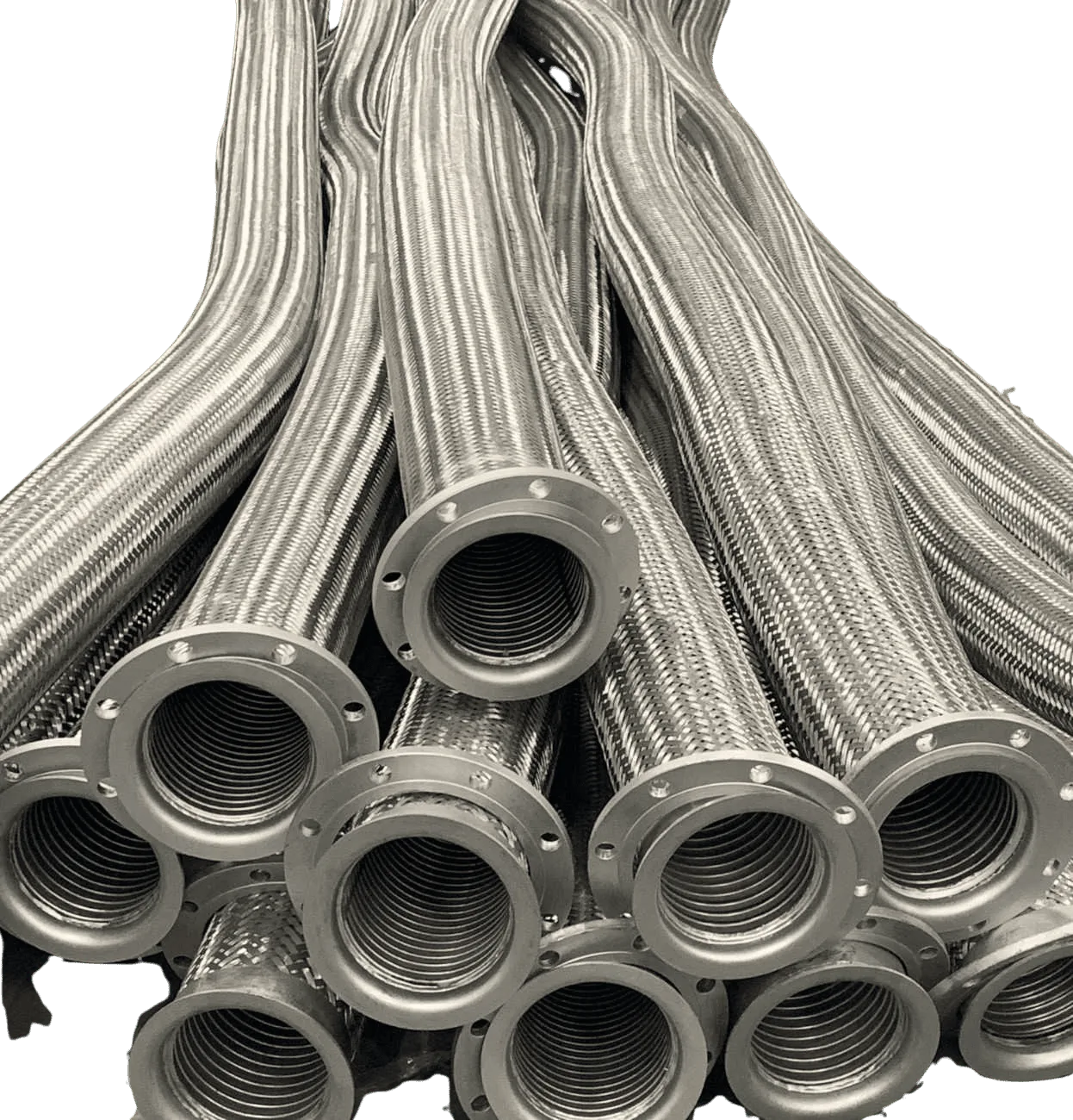
All-metal alternative where no liner is wanted at all, in AISI 304, 321 or 316L with stainless braid.
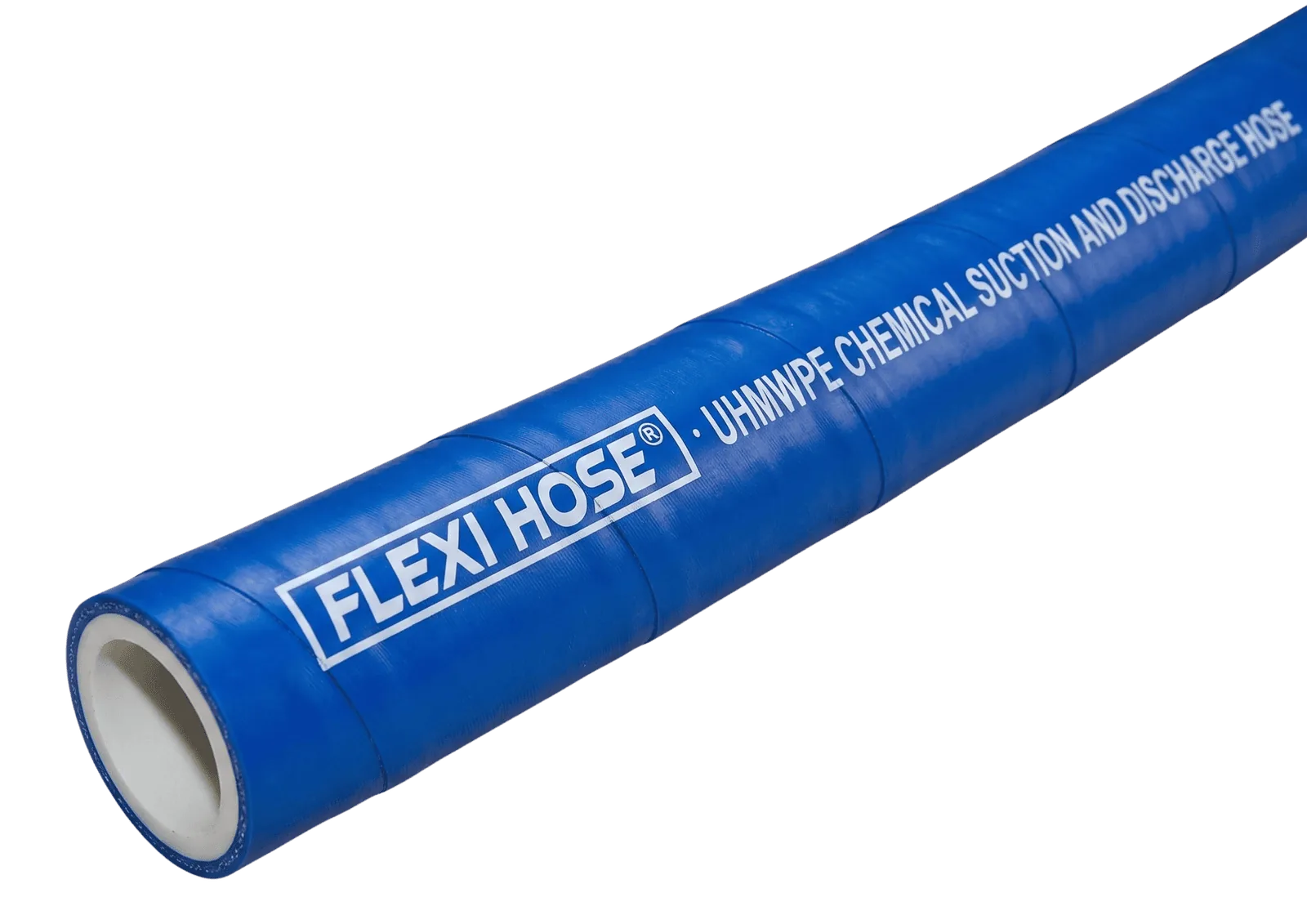
Large bore chemical transfer, where the requirement is volume rather than pressure or extreme heat.

The rubber option for saturated steam where +232 °C is sufficient and a lined hose is not required.
PTFE Hose Size, Pressure and Bend Radius Table — All 15 Sizes
PSI and BAR pairs are published exactly as catalogued and are not recalculated. Bursting pressure is four times working pressure at every size. W.T. is wall thickness, in the units printed in the catalogue.
| I.D. (mm) | I.D. (inch) | O.D. (mm) | W.T. | Working pressure (PSI) | Working pressure (BAR) | Bursting pressure (PSI) | Bursting pressure (BAR) | Min. bend radius (mm) |
|---|---|---|---|---|---|---|---|---|
| 3.5 | 1/8 inch | 6.7 | 1 | 3625 | 250 | 14500 | 1000 | 16 |
| 4.8 | 3/16 inch | 7.6 | 0.85 | 2973 | 205 | 11890 | 820 | 20 |
| 6.4 | 1/4 inch | 9.4 | 0.85 | 2719 | 188 | 10875 | 750 | 27 |
| 8 | 5/16 inch | 11.1 | 0.85 | 2356 | 163 | 9425 | 650 | 27 |
| 10 | 3/8 inch | 13.1 | 0.85 | 1885 | 130 | 7540 | 520 | 33 |
| 10.3 | 13/32 inch | 13.5 | 0.85 | 1813 | 125 | 7250 | 500 | 46 |
| 12.7 | 1/2 inch | 16.2 | 0.8 | 1631 | 113 | 6525 | 450 | 66 |
| 16 | 5/8 inch | 19.4 | 1 | 1160 | 80 | 4640 | 320 | 150 |
| 19 | 3/4 inch | 23 | 1.2 | 1015 | 70 | 4060 | 280 | 226 |
| 22.2 | 7/8 inch | 26.2 | 1.2 | 870 | 60 | 3480 | 240 | 245 |
| 25.4 | 1 inch | 29.8 | 1.5 | 725 | 50 | 2900 | 200 | 300 |
| 28 | 1.1/8 inch | 33 | 1.5 | 653 | 45 | 2610 | 180 | 600 |
| 32 | 1.1/4 inch | 38 | 2 | 562 | 39 | 2247.5 | 155 | 700 |
| 38 | 1.1/2 inch | 44 | 2 | 508 | 35 | 2030 | 140 | 800 |
| 50 | 2 inch | 56 | 2 | 435 | 30 | 1740 | 120 | 700 |
Two points in this table are worth reading carefully. The minimum bend radius grows very quickly above 16 mm bore — 150 mm at 5/8 inch, 600 mm at 1.1/8 inch and 800 mm at 1.1/2 inch — so a PTFE hose is far less tolerant of a tight route than a rubber hose of the same bore, and the routing has to be checked before the length is fixed. The 2 inch size then reads 700 mm, lower than the 1.1/2 inch figure above it; that is how the catalogue prints it and it is published unchanged.
How to Select a PTFE Hose
Media, temperature, pressure, bore, then routing. On this product the routing step is the one most often skipped, and it is the one that causes failures.
1. Confirm the medium justifies the liner
A PTFE hose is specified for oil, steam, acid, diesel, petroleum, chemical, pharmaceutical and food duty. If the medium is water, compressed air or hydraulic fluid within a rubber hose temperature range, a rubber grade will do the job at a fraction of the cost. The liner earns its price on aggressive media, not on ordinary ones.
2. Check the temperature at both extremes
Service is −65 °C to +260 °C. The upper figure is what usually drives the selection, but the lower one matters on cryogenic and refrigerant duty where rubber has gone glass-hard. Take the peak process temperature including steam-out and clean-in-place cycles rather than the normal running figure.
3. Read pressure against the size, not the range
Working pressure falls steeply with bore: 3625 PSI / 250 BAR at 1/8 inch, 1631 PSI / 113 BAR at 1/2 inch, 725 PSI / 50 BAR at 1 inch and 435 PSI / 30 BAR at 2 inch. Quoting the headline 250 BAR figure against a 1 inch requirement over-states the hose by five times, which is the single most common specification error on this product.
4. Size the bore on flow, then re-check pressure
Fifteen sizes are catalogued from 3.5 mm to 50 mm internal diameter. Because pressure and bore move against each other here, a bore increase made for flow reasons has to be re-checked against the pressure column rather than assumed to be safe.
5. Check the bend radius against the actual route
Minimum bend radius runs from 16 mm at 1/8 inch to 800 mm at 1.1/2 inch. A 1.1/8 inch PTFE hose needs 600 mm of clear radius, which is a much larger loop than most people picture when they measure a run. Measuring the route in three dimensions before fixing the assembly length avoids ordering a hose that cannot be installed.
6. Specify the end fittings with the enquiry
A PTFE hose is supplied as an assembly rather than as coil stock, so the end connection is part of the product rather than an accessory. Sending the fitting type, thread or flange standard and the overall assembly length with the first enquiry is what allows a single quotation instead of three rounds of clarification.
Where PTFE Hose Is Used in Saudi Arabia
The Kingdom’s chemical, refining and pharmaceutical sectors are where an inert liner stops being a luxury.
Petrochemical and refinery process lines
Jubail and Yanbu run solvents, aromatics and catalysts that permeate or swell a rubber tube over time. A PTFE hose on sample points, pump connections and additive injection lines removes the permeation question entirely, which is why it appears repeatedly in specifications across both complexes.
Acid and aggressive chemical transfer
Sulphuric, hydrochloric and nitric acid handling at fertiliser and processing plants is the classic PTFE duty. The liner is close to chemically inert, so the specification argument shifts from which rubber compound survives longest to which fitting material is compatible.
Steam and thermal fluid at high temperature
Where a two wire braid rubber steam hose tops out at +232 °C, the PTFE hose is catalogued to +260 °C. Thermal oil circuits, high-pressure steam tracing and jacketed line connections across Saudi industrial plant sit in that gap.
Pharmaceutical and food production
Nothing leaches from a PTFE liner and it withstands repeated steam sterilisation and clean-in-place cycles. The growing pharmaceutical and food manufacturing base around Riyadh, Jeddah and Sudair uses the smaller bores for transfer and filling lines on exactly that basis.
Paint, coating and solvent handling
Solvent-based coatings destroy ordinary rubber quickly. Fabrication yards, pipe coating plants and the automotive and appliance manufacturing around Dammam use small bore PTFE assemblies on paint circulation and solvent flush lines where a rubber hose would be a monthly replacement.
Instrumentation and analyser tubing
Sample lines to gas chromatographs and process analysers must not contaminate the sample. The 1/8 inch to 1/4 inch sizes, which are also the highest pressure sizes in the range at 3625 and 2719 PSI, are used for this across Saudi process plant.
Why Buy PTFE Hose Direct from the Manufacturer
Vardhman Hydraulic Hoses Pvt. Ltd. has manufactured under the FLEXI HOSE® brand since 1980, from a single plant at Bhiwadi, Rajasthan.
Factory direct, no trading layer
You buy from the plant that mixes the compound and builds the hose. That means the specification you are quoted is the specification that is manufactured, and a technical question is answered by the people who made the product rather than by a reseller.
Fifteen sizes, not a stocked handful
The range runs from 3.5 mm to 50 mm and includes 10.3 mm, 22.2 mm and 28 mm alongside the round sizes. Those odd bores exist because instrumentation and process equipment specify them, and matching the equipment avoids an adaptor at the joint carrying the most aggressive medium.
Built as assemblies to your drawing
A PTFE hose is not cut from a coil on site. Length, fitting type and orientation are fixed at manufacture, so the assembly arrives ready to install. Building it at the plant that made the hose keeps the liner, the braid and the end connection the responsibility of one supplier.
Rubber, metallic and lined from one source
Most process plants need all three. Ordering the PTFE hose alongside steam, hydraulic, transfer and stainless grades on a single purchase order removes a vendor from the approval process and consolidates four families into one container.
Complete export document set
Every shipment carries a commercial invoice, packing list, certificate of origin, bill of lading and test certificates. Terms are FOB, CIF or CFR ex Nhava Sheva (JNPT) or Mundra Port, so customs clearance at the Saudi port is not held up on paperwork.
Delivery, Ports and Transit to Saudi Arabia
Shipped ex Nhava Sheva (JNPT) or Mundra Port on FOB, CIF or CFR terms. Transit times below are sea transit and exclude clearance.
| Saudi port | Serves | Transit (days) |
|---|---|---|
| Jubail | Jubail Industrial City, petrochemical and fertiliser complex | 8–10 |
| Yanbu | Yanbu Industrial City, Red Sea refining and petrochemicals | 8–10 |
| Dammam | Eastern Province manufacturing, Riyadh and Sudair onward haulage | 7–10 |
| Jeddah | Western Region pharmaceutical and food production, Rabigh | 7–9 |
| Riyadh | Inland via Dammam, dry port clearance for central industrial cities | 9–12 |
| NEOM / Tabuk | North-west projects, Duba onward | 10–14 |
Because every PTFE hose is built as a made-to-length assembly, the production window rather than the sea transit is usually what sets the delivery date. Sending sizes, lengths and fitting details with the enquiry lets manufacture start on order confirmation instead of after a drawing exchange.
Four Product Families, 26 Catalogued Products
The lined metallic grade sits inside a full catalogue exported from one plant, so a mixed order ships as one consignment.

Air, water, steam, sand blast, rock drill, cable coolant and UHMWPE grades.
- Air Hose Type 1 & Type 2
- Steam Hose, 1 and 2 wire braid
- Sand Blast Hose

SAE 100 R1, R2, R3 and R6 plus EN 856 four spiral grades.
- SAE 100 R1 AT and R2 AT
- SAE 100 R3 and R6
- EN 856 4SP / 4SH
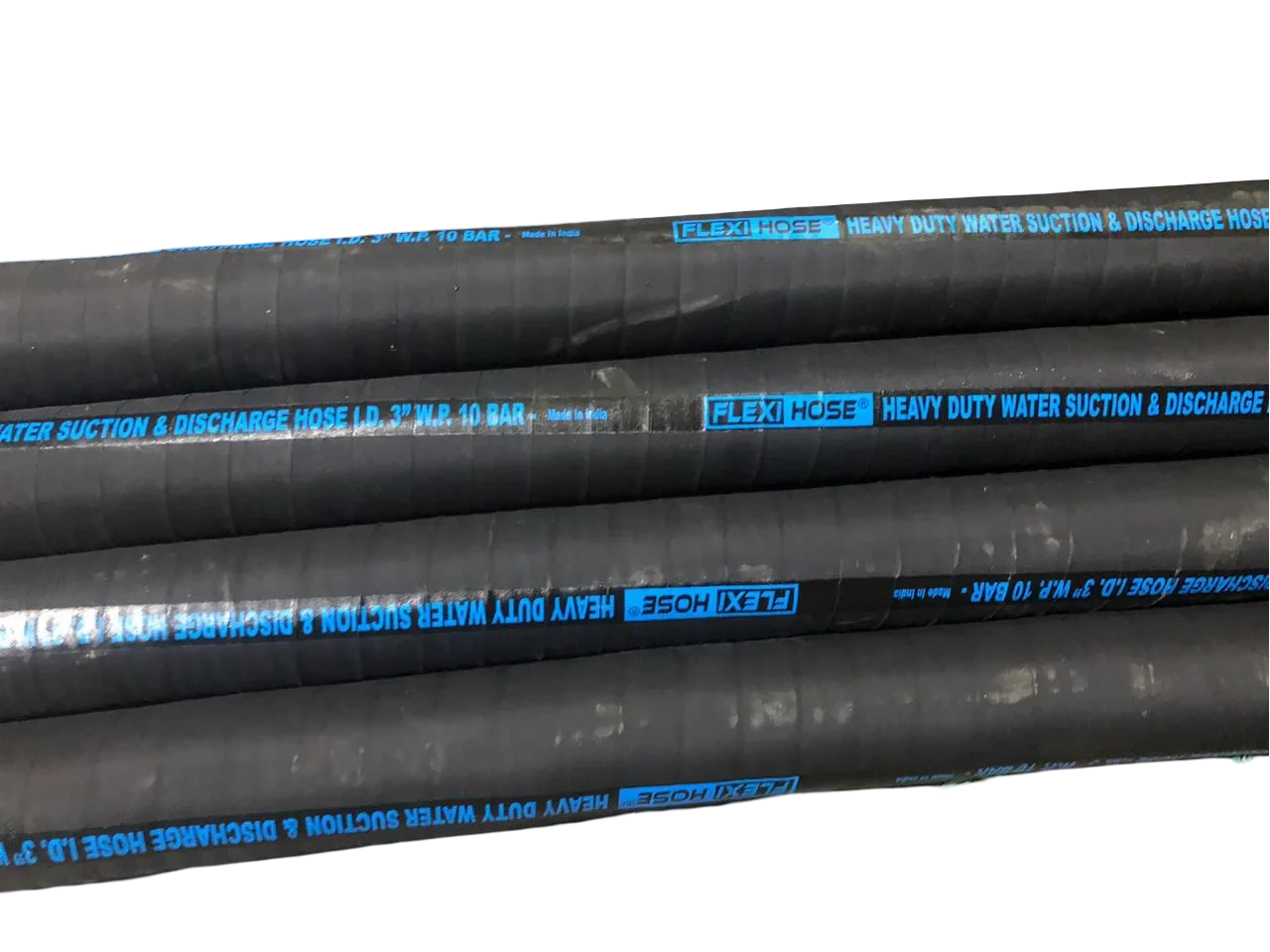
The 10 bar large bore series for water, oil and solids.
- Water Suction & Discharge
- Oil Suction & Discharge
- Bulk Material and Lay Flat
Corrugated stainless steel, PTFE lined hose and insulating matting.
- SS Flexible Hose, EN ISO 10380
- SS PTFE Teflon Hose
- Electrical Insulating Mat
Request a PTFE Hose Quotation for Saudi Arabia
Send internal diameter, assembly length, end fitting type and standard, the medium, peak temperature and your discharge port. A quotation with specification, test certificate scope and transit window follows on the same working day wherever possible. Price on request — we do not publish list pricing.
People Also Ask
Short answers to the questions Saudi process, chemical and maintenance buyers search for most often.
What is a PTFE hose used for?
High temperature and chemically aggressive duty: oil, steam, acid, diesel, petroleum, chemical, pharmaceutical and food industry service. It is chosen where an elastomer tube would swell, permeate or soften rather than where pressure alone is the problem.
Is PTFE hose the same as Teflon hose?
Yes. Teflon is a trade name for polytetrafluoroethylene, and the two terms describe the same material. This product is catalogued as SS PTFE Teflon Hose — a PTFE liner with a stainless steel braid over it.
What temperature can a PTFE hose handle?
−65 °C to +260 °C. That is about 28 °C above the two wire braid rubber steam hose at the top of the range, and far below what any rubber grade will tolerate at the bottom.
What is the maximum pressure?
3625 PSI / 250 BAR working at the 1/8 inch size, which is the smallest and highest rated in the range. Pressure falls as bore rises, reaching 435 PSI / 30 BAR at 2 inch. Bursting pressure is four times working pressure at every size.
Why does the bend radius matter so much?
Because it grows faster than the bore does. A 1/8 inch hose bends to 16 mm, but a 1.1/2 inch hose needs 800 mm of clear radius. A route that suits a rubber hose of the same bore will often be too tight for a PTFE assembly.
What sizes are exported to Saudi Arabia?
All fifteen catalogued internal diameters from 3.5 mm to 50 mm, which is 1/8 inch to 2 inch. Assemblies are built to length with the specified end fittings and can ship alongside the rubber and stainless families on one order.
PTFE Hose — Frequently Asked Questions
Specification, construction and export questions, answered from the FLEXI HOSE® catalogue.
The inner liner is polytetrafluoroethylene, extruded as a smooth tube, with a stainless steel wire braid applied over it. The liner provides chemical resistance and temperature capability; the braid carries the pressure. Wall thickness runs from 0.8 to 2 in the units printed in the catalogue, varying with size.
Fifteen internal diameters: 3.5, 4.8, 6.4, 8, 10, 10.3, 12.7, 16, 19, 22.2, 25.4, 28, 32, 38 and 50 mm. In inches that is 1/8 through to 2 inch, including the 13/32, 7/8 and 1.1/8 inch sizes that instrumentation and process equipment often specify.
From 3625 PSI / 250 BAR at 1/8 inch down to 435 PSI / 30 BAR at 2 inch. Intermediate figures include 2719 PSI / 188 BAR at 1/4 inch, 1631 PSI / 113 BAR at 1/2 inch and 725 PSI / 50 BAR at 1 inch. The full table of all fifteen sizes is published above.
Bursting pressure is four times working pressure at every catalogued size, from 14500 PSI / 1000 BAR at 1/8 inch to 1740 PSI / 120 BAR at 2 inch. Burst is a destructive test figure that demonstrates the safety margin; it is not an operating allowance.
Because the catalogue prints them as pairs and they are reproduced exactly as printed rather than converted. Recalculating one from the other independently can produce a number that does not match the figure the hose was built and tested against.
The catalogued application is high temperature service on oil, steam, acid, diesel, petroleum, chemical, pharmaceutical and food industry media. PTFE is close to chemically inert, so on most process duties the compatibility question moves to the end fitting material rather than the liner.
Both are stainless braided products in the same family. The PTFE hose has a polymer liner and runs to +260 °C in fifteen sizes to 50 mm bore. The SS flexible hose is all metal, an annular corrugated stainless core to EN ISO 10380, catalogued in fifteen sizes from 6 mm to 150 mm at 110 bar down to 10 bar.
As an assembly. Length and end fittings are fixed at manufacture rather than cut and fitted on site, which is why the fitting type, thread or flange standard and overall length need to be stated with the enquiry rather than agreed afterwards.
No. Only three FLEXI HOSE products carry a BIS licence: Water Hose to IS 444-2017 Type 2 under CM/L 8400124510, and Air Hose Type 1 and Type 2 to IS 446-2017. No BIS or Indian Standard claim is made for the PTFE hose.
Ex Nhava Sheva (JNPT) or Mundra Port on FOB, CIF or CFR terms, with sea transit of 8 to 10 days to Jubail and Yanbu, 7 to 10 to Dammam and 7 to 9 to Jeddah. Because assemblies are made to order, the manufacturing window rather than the sea leg usually sets the delivery date.