
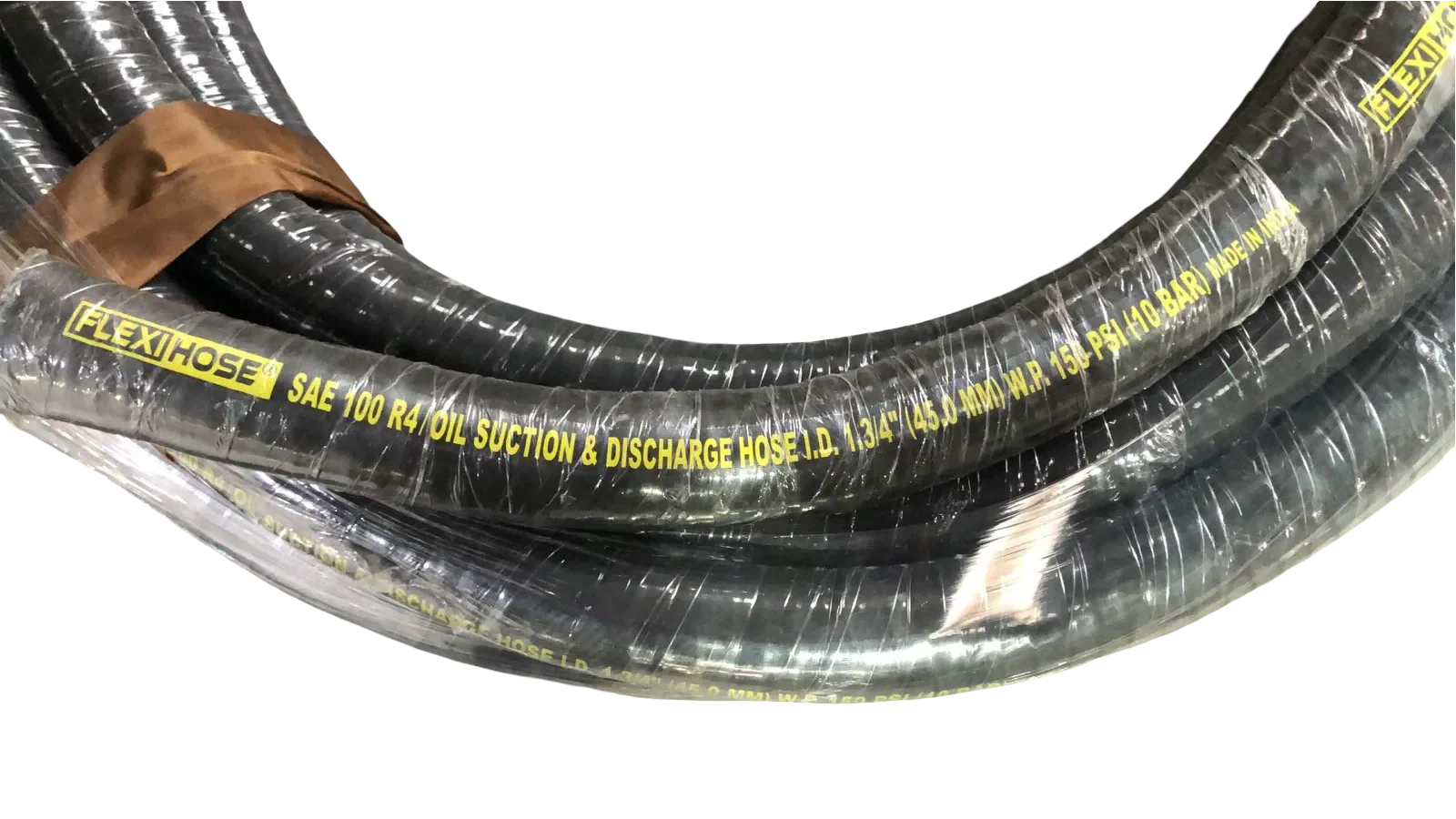
Oil Suction Hose Supplier in Saudi Arabia — 11 Bore Sizes, NBR Lined
Oil suction hose is a helix-reinforced large bore hose for the suction and delivery of fuel and mineral oils having aromatic contents up to 50 per cent. FLEXI HOSE® oil suction hose is catalogued in eleven bores from 19 mm (3/4 inch) to 203 mm (8 inch), rated 10 bar / 150 psi working, 30 bar / 450 psi minimum burst and 0.9 bar vacuum, with a service temperature of −20 °C to +80 °C.
Shipping outside India? See our full hose exporter in India — Incoterms, export documentation and port of dispatch.
What Is an Oil Suction Hose?
An oil suction hose is a large bore hose with a nitrile rubber tube and an embedded helical steel wire, built to move fuel and mineral oils in both directions — drawn out of a tank under vacuum and delivered under pressure. Two features define it. The nitrile tube resists hydrocarbon attack up to 50 per cent aromatic content. The helix holds the bore round at up to 0.9 bar vacuum.
The FLEXI HOSE® construction adds a third element that a water grade does not have: a copper wire laid in with the helix. Handling fuel generates static charge, and a continuous conductive path through the hose wall is what allows that charge to be bonded away at the coupling rather than accumulating in the hose. The cover is a black smooth fabric marked NBR/PVC compound, resistant to oil, fuel, weather, ozone and abrasion.
Saudi Arabia runs more of this duty than almost any market. Refinery and terminal work at Jubail, Yanbu, Rabigh and Ras Tanura, road tanker loading and discharge across the distribution network, marine bunkering at the Gulf and Red Sea ports, and diesel transfer to remote plant and generator sets all specify an oil suction hose rather than a general purpose hose. For water and sewage the SBR-lined water suction hose applies instead; the complete large bore family is listed on the suction and discharge hose page.
On This Page
Jump straight to the oil suction hose information you need.
Oil Suction Hose in the FLEXI HOSE® 10 Bar Transfer Range
The 10 bar large bore series shares one pressure class and differs by tube compound. The nitrile grade is the hydrocarbon member of that family. Every figure below is taken verbatim from the FLEXI HOSE® catalogue.
The grade covered on this page. Smooth black NBR tube, synthetic plies with helix steel wire and copper wire, NBR/PVC fabric marked cover.
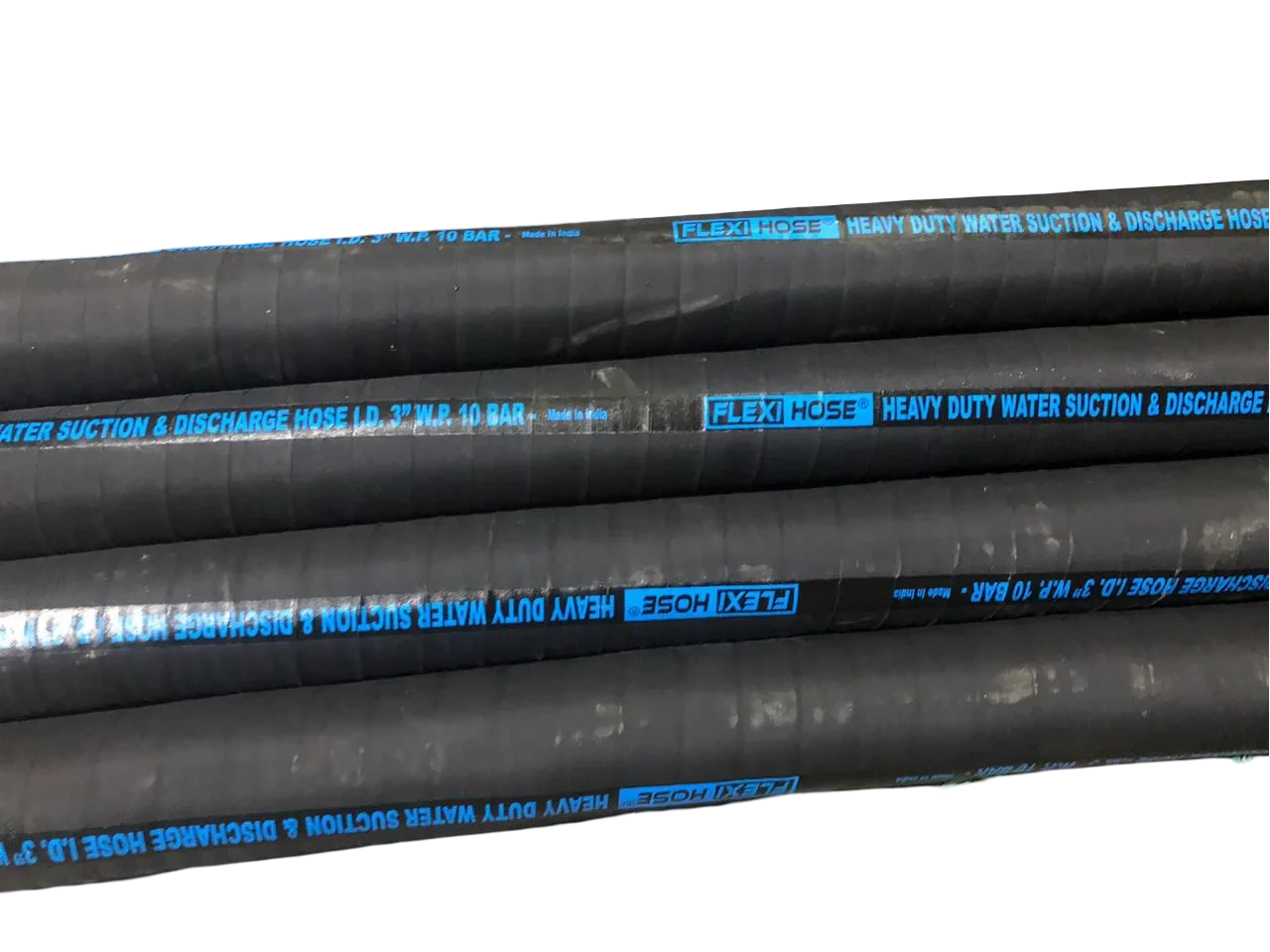
For water and sewage discharge in mining, construction and industry. Same pressure class, but the SBR tube must not be used on hydrocarbons.
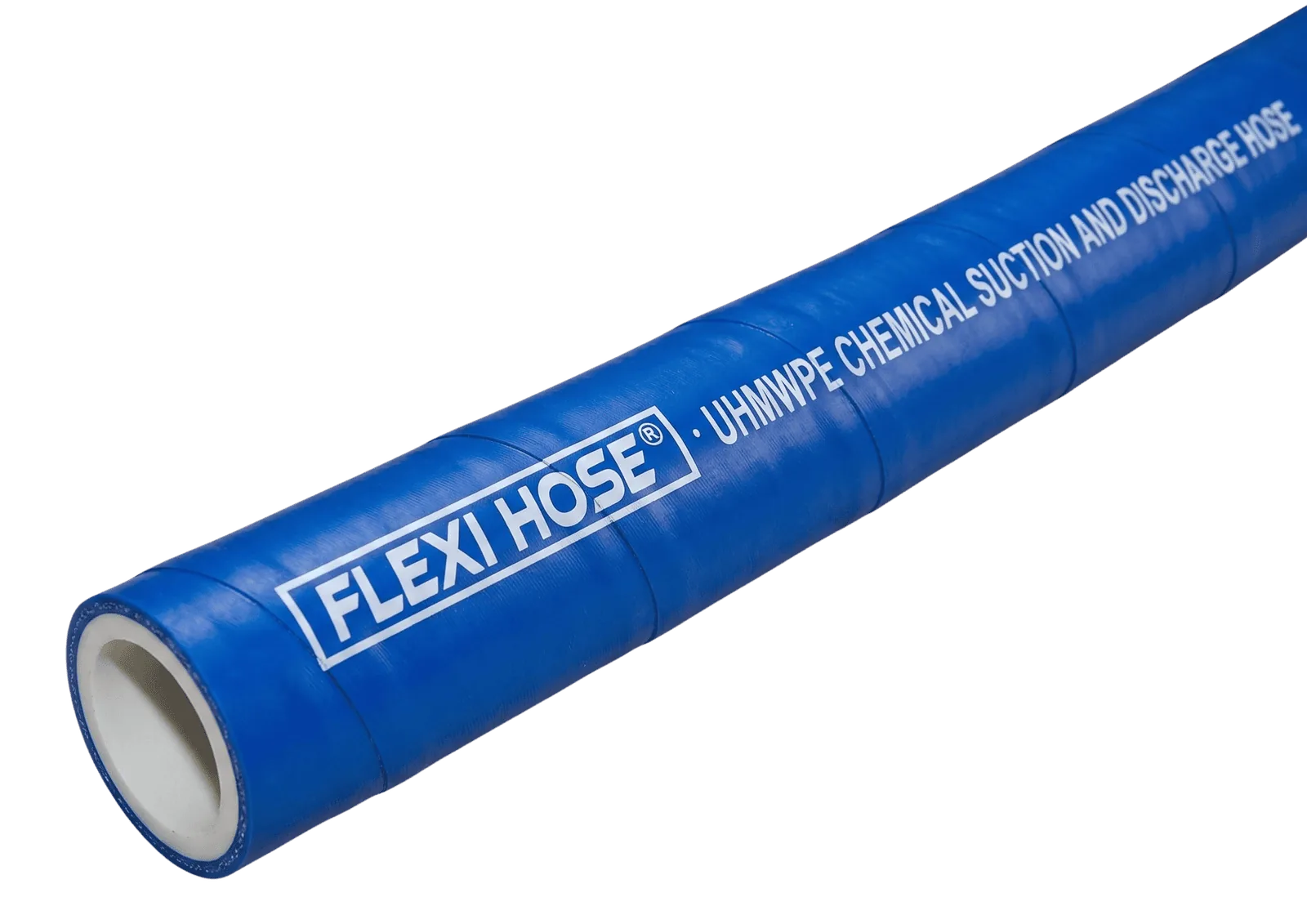
Where the medium is a solvent or corrosive chemical rather than a fuel or mineral oil. Higher pressure class at 240 PSI / 16 BAR.

Highly abrasion resistant NR/SBR tube for dry solids and slurry. Catalogued 25 mm to 203 mm at the same 10 bar class.
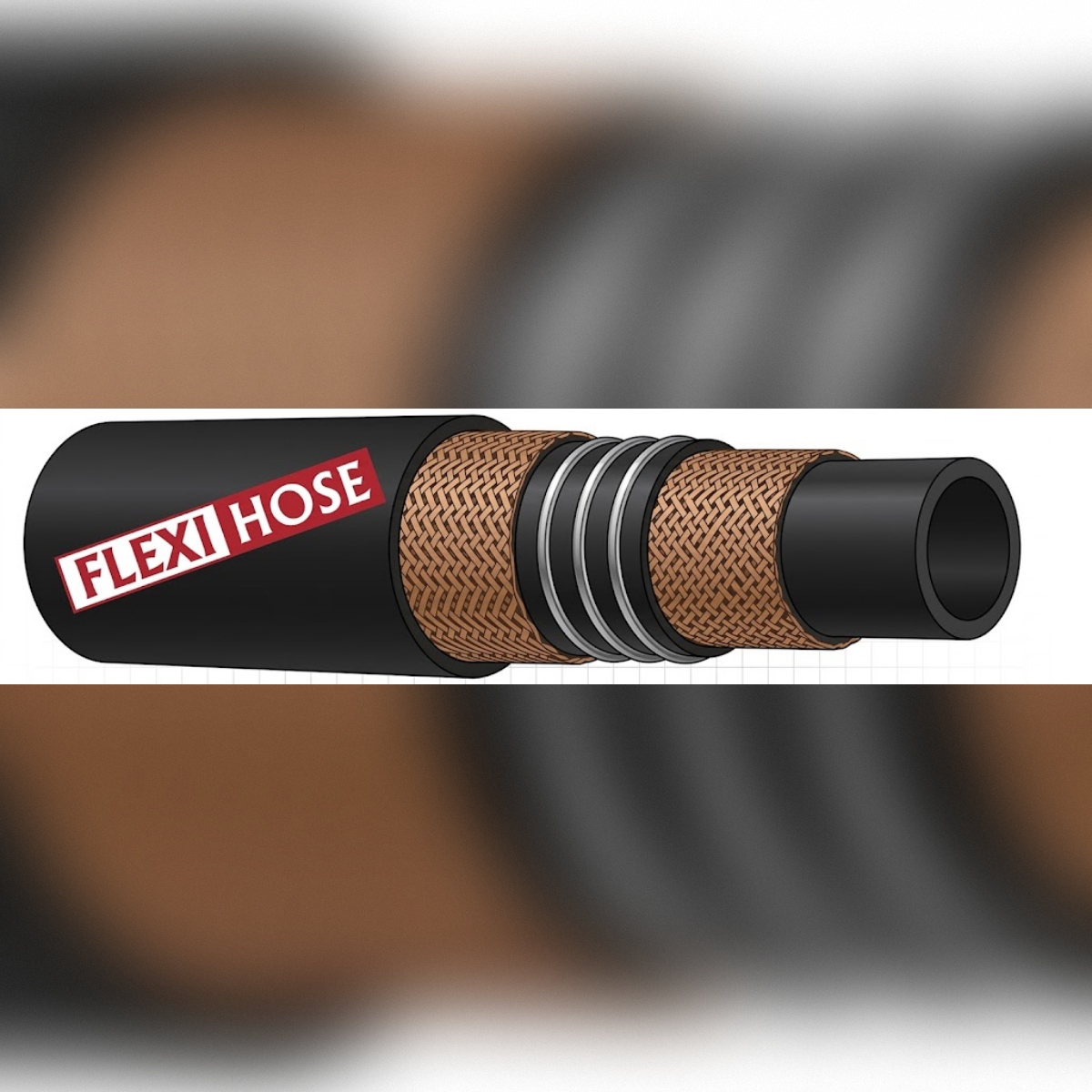
Water discharge only, no helical wire and no vacuum rating. Listed here for completeness — it is not an alternative on a fuel line.
Oil Suction Hose Size and Pressure Table
All eleven catalogued bores. Pressures are published exactly as printed in the FLEXI HOSE® catalogue and are not converted or recalculated.
| ID (mm) | ID (inch) | OD (mm) | WP (bar) | WP (psi) | Burst (bar) | Burst (psi) | Vacuum (bar) | Coil (m) |
|---|---|---|---|---|---|---|---|---|
| 19 | 3/4 inch | 29 | 10 | 150 | 30 | 450 | 0.9 | 20 |
| 25 | 1 inch | 35 | 10 | 150 | 30 | 450 | 0.9 | 20 |
| 32 | 1.1/4 inch | 42 | 10 | 150 | 30 | 450 | 0.9 | 20 |
| 38 | 1.1/2 inch | 49 | 10 | 150 | 30 | 450 | 0.9 | 20 |
| 51 | 2 inch | 63 | 10 | 150 | 30 | 450 | 0.9 | 20 |
| 63.5 | 2.1/2 inch | 77 | 10 | 150 | 30 | 450 | 0.9 | 20 |
| 76 | 3 inch | 90 | 10 | 150 | 30 | 450 | 0.9 | 20 |
| 102 | 4 inch | 118 | 10 | 150 | 30 | 450 | 0.9 | 20 |
| 127 | 5 inch | 143 | 10 | 150 | 30 | 450 | 0.9 | 20 |
| 152 | 6 inch | 171 | 10 | 150 | 30 | 450 | 0.9 | 20 |
| 203 | 8 inch | 225 | 10 | 150 | 30 | 450 | 0.9 | 20 |
Construction: smooth black NBR rubber compound tube; high tensile synthetic plies with helix steel wire and a copper wire; black smooth fabric marked NBR/PVC cover resistant to oil, fuel, weather, ozone and abrasion. Service temperature −20 °C to +80 °C. Coil length is 20 m on every bore of this oil suction hose, including 203 mm, so a large bore order does not carry a shorter coil penalty.
How to Select an Oil Suction Hose
Four decisions, in this order. On fuel duties the compound question comes before everything else, because the failure mode is chemical rather than mechanical.
1. Establish the aromatic content
This is the number that decides whether an oil suction hose is suitable at all. The catalogued limit is aromatic content up to 50 per cent, covering diesel, gas oil, lubricating oils and most mineral oil grades. Above that figure the nitrile tube is outside its rated envelope and a different lining is required. Ask the fuel supplier for the figure rather than estimating it.
2. Confirm the hose sees suction
If the pump draws from a tank, a tanker compartment, a sump or a below-grade line, the helix-reinforced grade rated 0.9 bar vacuum is mandatory. A discharge-only hose has no wire and will flatten on the first suction stroke. On a fuel line a collapsed hose is not just a stoppage, it is a spill.
3. Confirm bonding and static control
The copper wire laid alongside the helix gives a conductive path through the wall. It only does its job if it is properly terminated at the couplings, so bonding continuity must be checked at assembly and at each inspection. This step is routinely skipped and it is the one that matters most on a fuel transfer line.
4. Confirm bore, pressure and temperature
All eleven bores from 19 mm to 203 mm carry 10 bar / 150 psi working and 30 bar / 450 psi minimum burst. Service temperature is −20 °C to +80 °C. Bore follows flow rate and the tanker or pump connection. Standard coil length is 20 m across the whole range.
Where Oil Suction Hose Is Used in Saudi Arabia
The Saudi duty profile is hydrocarbon handling: refining, distribution, bunkering and remote power.
Refinery and terminal transfer
Jubail, Yanbu, Rabigh and Ras Tanura run continuous product movement between tankage, road loading and jetty lines. Flexible sections are used where a rigid line cannot absorb movement, and the mid to large bores are the ones consumed in volume.
Road tanker loading and discharge
The distribution fleet loads at terminals and discharges at retail stations, industrial sites and remote camps. The 51 mm to 102 mm bores dominate this duty, and the abrasion resistant cover matters because the hose is dragged across concrete several times a day.
Marine bunkering and port fuelling
Gulf and Red Sea ports fuel vessels from barge and quayside. Suction capability is needed because product is drawn from barge tanks, and the 0.9 bar vacuum rating is the specification point a port operator will ask to see.
Generator and remote plant diesel
Construction fronts, mining sites and telecom infrastructure across the Kingdom run diesel gensets refuelled from bowsers. Smaller bores from 19 mm to 51 mm cover this, and the oil resistant tube is what prevents the swelling that ends a general purpose hose in weeks.
Workshop and lubricant handling
Fleet workshops and heavy equipment yards transfer lubricating oil from drums and bulk tanks. The catalogued application explicitly covers lubricating oils, and the same hose serves both waste oil recovery and fresh oil filling.
Spill response and tank cleaning
Emergency crews need a hose that will lift product, not just push it. Because an oil suction hose is rated for both directions, a single reserve coil covers recovery from a bund and transfer into a holding tank without a second specification.
Why Buy Oil Suction Hose Direct from the Manufacturer
Vardhman Hydraulic Hoses Pvt. Ltd. has manufactured under the FLEXI HOSE® brand since 1980, from a single plant at Bhiwadi, Rajasthan.
Factory direct, no trading layer
You buy from the plant that mixes the compound and builds the hose. That means the specification you are quoted is the specification that is manufactured, and a technical question is answered by the people who made the product rather than by a reseller.
Nitrile compound mixed in house
The oil resistance of an oil suction hose is a property of the compound, not of the label. Mixing is done in the same plant that builds the hose, which is why the aromatic content limit quoted is the limit the tube is formulated to rather than a figure carried over from a supplier datasheet.
Conductive path built into the wall
The copper wire is laid in during construction alongside the helix, not added afterwards. On a fuel transfer line static control is a safety requirement, and building the conductive element into the reinforcement is what makes bonding continuity checkable at the coupling.
Full 20 metre coils to 8 inch
Every bore including 203 mm is catalogued at 20 m. Terminal and jetty runs are long, and a full coil means fewer joints on a hydrocarbon line. Fewer joints is fewer leak paths, which is the argument a terminal HSE engineer responds to.
Complete export document set
Every shipment carries a commercial invoice, packing list, certificate of origin, bill of lading and test certificates. Terms are FOB, CIF or CFR ex Nhava Sheva (JNPT) or Mundra Port, so customs clearance at the Saudi port is not held up on paperwork.
Delivery, Ports and Transit to Saudi Arabia
Shipped ex Nhava Sheva (JNPT) or Mundra Port on FOB, CIF or CFR terms. Transit times below are sea transit and exclude clearance.
| Saudi port | Serves | Transit (days) |
|---|---|---|
| Jubail | Jubail Industrial City, petrochemical and refining | 8–10 |
| Yanbu | Yanbu Industrial City, Red Sea refining | 8–10 |
| Dammam | Eastern Province, Ras Tanura onward haulage | 7–10 |
| Jeddah | Western Region, Rabigh, Red Sea distribution | 7–9 |
| Riyadh | Inland via Dammam, dry port clearance | 9–12 |
| NEOM / Tabuk | North-west projects, Duba onward | 10–14 |
Saudi port operations are administered by Mawani, the Saudi Ports Authority. Terminals and bunkering operators normally hold replacement coils on the shelf rather than ordering against a failure, because a fuel line out of service stops loading. Ordering an oil suction hose on a replenishment cycle rather than a breakdown cycle is the difference between a planned shipment and an expensive one.
Four Product Families, 26 Catalogued Products
The nitrile transfer grade sits inside a full range exported from one plant, so a mixed order ships as one consignment.

Air, water, steam, sand blast, rock drill, cable coolant and UHMWPE grades.
- Air Hose Type 1 & Type 2
- Steam Hose, 1 and 2 wire braid
- Sand Blast Hose

SAE 100 R1, R2, R3 and R6 plus EN 856 four spiral grades.
- SAE 100 R1 AT and R2 AT
- SAE 100 R3 and R6
- EN 856 4SP / 4SH
The 10 bar large bore series, nitrile fuel grade included.
- Oil Suction & Discharge
- Water Suction & Discharge
- Bulk Material and Lay Flat
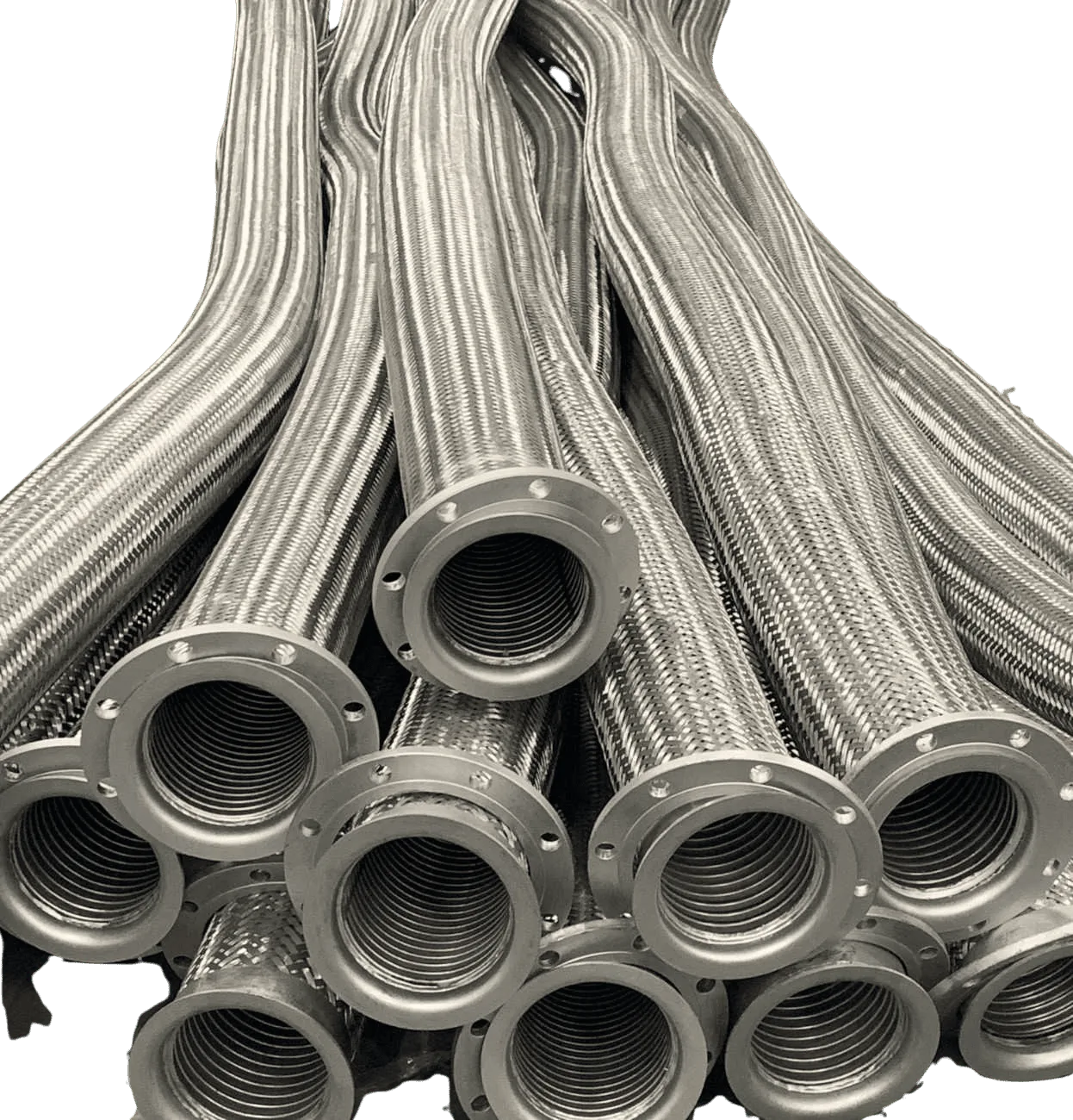
Corrugated stainless steel, PTFE lined hose and insulating matting.
- SS Flexible Hose, EN ISO 10380
- SS PTFE Teflon Hose
- Electrical Insulating Mat
Request an Oil Suction Hose Quotation for Saudi Arabia
Send bore, quantity in metres or coils, the product being handled and your discharge port. A quotation with specification, test certificate scope and transit window follows on the same working day wherever possible. Price on request — we do not publish list pricing.
People Also Ask
Short answers to the questions Saudi fuel and terminal buyers search for most often.
What aromatic content can an oil suction hose handle?
The catalogued limit is aromatic content up to 50 per cent. That covers diesel, gas oil, lubricating oils and most mineral oil grades. Above 50 per cent the nitrile tube is outside its rated envelope and a different lining should be specified.
Why does the hose contain a copper wire?
Handling fuel generates static charge. The copper wire laid alongside the helical steel wire provides a conductive path through the hose wall, so charge can be bonded away at the coupling instead of accumulating. It must be correctly terminated at both ends to work.
Can a water hose be used for diesel transfer instead?
No. An SBR or general purpose rubber tube swells and degrades in contact with hydrocarbons, and it carries no conductive element. Diesel and mineral oil duties require the nitrile-lined grade rated for the aromatic content of the product.
What is the pressure rating across the size range?
10 bar / 150 psi working pressure and 30 bar / 450 psi minimum burst on every bore from 19 mm to 203 mm, with a 0.9 bar vacuum rating throughout. The rating does not fall away at the larger bores.
What temperature range is the hose rated to?
Service temperature is −20 °C to +80 °C. That is a narrower cold limit than the water grade because the nitrile compound is formulated for oil resistance rather than low temperature flexibility. Check product temperature at loading, not just ambient.
What coil length is supplied?
20 metres on every catalogued bore, including the 203 mm size. Full coils reduce the number of couplings on a run, which matters on hydrocarbon lines where every joint is a potential leak path.
Oil Suction Hose — Frequently Asked Questions
Specification, safety and export questions, answered from the FLEXI HOSE® catalogue.
The FLEXI HOSE oil suction hose has a smooth black NBR rubber compound tube, reinforcement of high tensile synthetic plies with a helix steel wire and a copper wire, and a black smooth fabric marked NBR/PVC cover that is oil, fuel, weather, ozone and abrasion resistant. The helix gives the 0.9 bar vacuum rating and the copper wire gives the conductive path.
Suction and delivery of fuel and mineral oils having aromatic contents up to 50 per cent. In practice that means diesel, gas oil, kerosene grades, lubricating oils and similar mineral products. Solvents and aggressive chemicals fall outside this grade and are handled by the UHMWPE lined hose.
Eleven bores: 19, 25, 32, 38, 51, 63.5, 76, 102, 127, 152 and 203 mm, which is 3/4 inch to 8 inch. Outside diameters run 29 mm to 225 mm. All eleven sizes are exported, and a mixed-bore order ships as one consignment.
The construction includes a copper wire in the reinforcement, laid in with the helix, which provides a conductive path through the hose wall. Bonding continuity depends on correct termination at the couplings and should be verified at assembly and at each periodic inspection on site.
Three differences. The tube is NBR rather than SBR, so it resists hydrocarbons. The reinforcement carries a copper wire as well as the steel helix. And the service temperature is −20 °C to +80 °C rather than −30 °C to +80 °C. Pressure class, burst and vacuum rating are identical.
The catalogue lists the product in coils. End connections are quoted as a separate line, so state the coupling type and standard used on your site — camlock, flanged, or a terminal specific pattern — with the enquiry. On fuel lines the coupling also carries the bonding termination, so it should be specified deliberately.
No. The BIS licences held by Vardhman Hydraulic Hoses cover the Water Hose to IS 444-2017 Type 2 and the Air Hose to IS 446-2017.
Pressure and dimensional checks are run in an in-house laboratory using equipment calibrated by NABL-accredited bodies. Batch test certificates travel with the shipment alongside the commercial invoice, packing list, certificate of origin and bill of lading.
Sea transit from Nhava Sheva or Mundra is 8 to 10 days to both Jubail and Yanbu, 7 to 10 days to Dammam, 7 to 9 days to Jeddah, 9 to 12 days to Riyadh via Dammam and 10 to 14 days to NEOM and Tabuk. Those windows exclude customs clearance and inland haulage.
Coiled at or above the minimum bend radius, drained, capped and kept out of direct sun. Nitrile compounds age faster under UV and ozone exposure than under service load, so a hose that spends most of its life on a rack in the open will reach end of life sooner than its running hours suggest.
Vardhman Hydraulic Hoses Pvt. Ltd., manufacturing under the FLEXI HOSE brand since 1980 from F-621, Phase-1, RIICO Industrial Area, Bhiwadi 301019, Rajasthan, India.