Exceeds IS 10655 Type 2 and Type 3

Steam Hose Manufacturer in India, Exceeds IS 10655 Type 2 and Type 3

Industrial rubber steam hose with a heat-resistant EPDM tube and cover and brass-coated steel wire braid, in bores from 1/2″ to 2″ (12.50 to 50.00 mm) at 145 PSI / 10 BAR, and from 1/2″ to 1-1/4″ at 250 PSI / 17 BAR. Service to +195 C and +232 C. Made at our own works in Bhiwadi, Rajasthan.

FLEXI HOSE rubber steam hose, EPDM steam hose pipe with brass-coated steel wire braid, 145 PSI / 10 BAR working pressure, manufactured in Bhiwadi Rajasthan
Standard
Exceeds IS 10655 Type 2 & 3
Working pressure
145 PSI / 10 BAR
250 PSI / 17 BAR
Burst, minimum
1450 PSI / 100 BAR
2500 PSI / 170 BAR
Service temperature
−40 C to +195 C
−40 C to +232 C
Bore range
1/2″ to 2″
12.50 to 50.00 mm
EPDM tube and cover Brass-coated steel wire braid Ten in-house tests In the hose industry since 1980 Manufacturing since 1993

What an industrial steam hose is

A steam hose is a flexible rubber hose built to carry saturated or superheated steam under pressure. Flexihose makes two grades, both with a heat-resistant EPDM tube and cover and a braid of high-tensile brass-coated steel wire.

One wire braid: exceeds IS 10655 Type 2. 145 PSI / 10 BAR working, 1450 PSI / 100 BAR minimum burst, −40 C to +195 C, bore 1/2″ to 2″ (12.50 to 50.00 mm).

Two wire braid: exceeds IS 10655 Type 3. 250 PSI / 17 BAR working, 2500 PSI / 170 BAR minimum burst, −40 C to +232 C, bore 1/2″ to 1-1/4″ (12.50 to 31.00 mm).

Neither grade holds a BIS licence. Both exceed IS 10655 rather than conform to it, and we do not describe either as certified.

A steam hose is not a water hose rated hotter. Three things in the wall are different. The tube and cover are EPDM, which holds its properties in saturated steam and in the condensate that forms with it, where natural rubber and nitrile harden and craze. The reinforcement is steel wire rather than textile yarn, because textile loses tension through repeated heat cycling. And the burst margin is wide: 1450 PSI / 100 BAR behind a 145 PSI / 10 BAR working pressure, because a steam failure injures people.

This page is about industrial plant hose, not appliance parts. Search results for "steam hose" mix two unrelated products. One is a 3 mm silicone or PTFE tube for a steam iron or a garment steamer, sold as a spare for a few hundred rupees. The other is what is on this page: rubber hose in bores from 1/2″ to 2″, wire reinforced, for refineries, shipyards, chemical plants, steel mills and foundries. We make the second and not the first.

The two grades, and which one you need

Two numbers decide it: the pressure at the hose and the temperature at the hose. Read your duty off the plane below. If it falls inside the inner envelope, the one wire braid grade covers it. If it falls in the band between the two, you need the two wire braid grade.

Duty selection plane, maximum working pressure against service temperature The inner envelope is Type 2, one wire braid: working pressure up to 145 PSI / 10 BAR, service temperature -40 C to +195 C, bore 1/2 inch to 2 inch. The outer envelope is Type 3, two wire braid: working pressure up to 250 PSI / 17 BAR, service temperature -40 C to +232 C, bore 1/2 inch to 1-1/4 inch. The Type 3 envelope fully contains the Type 2 envelope on both axes. Beyond 250 PSI / 17 BAR or beyond +232 C is outside the published range. Beyond our published range, ask before ordering Type 3, two wire braid 250 PSI / 17 BAR, −40 C to +232 C Bore 1/2″ to 1-1/4″ Type 2, one wire braid 145 PSI / 10 BAR, −40 C to +195 C Bore 1/2″ to 2″ 0 145 PSI / 10 BAR 250 PSI / 17 BAR −40 C +195 C +232 C Maximum working pressure Service temperature
Locate your duty by pressure and temperature. The inner envelope is the one wire braid grade; the outer is the two wire braid grade.

Type 2, one wire braid

Exceeds IS 10655 Type 2
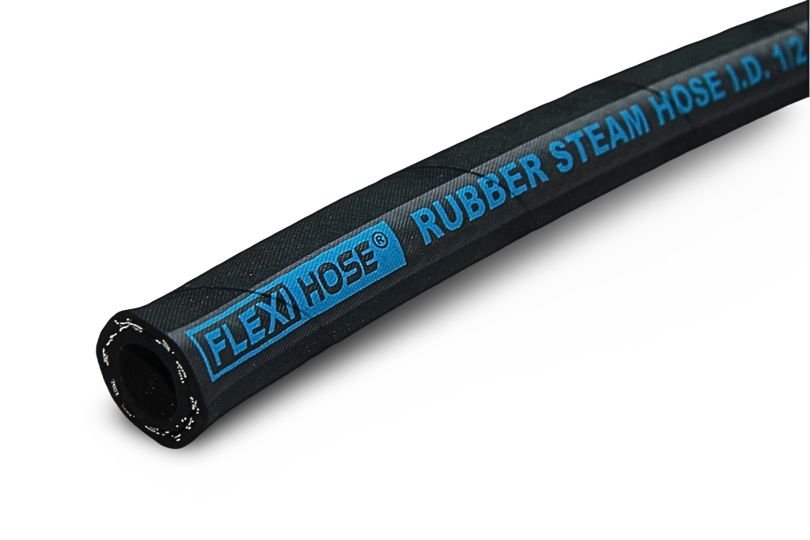
FLEXI HOSE rubber steam hose, type 2, one wire braid, EPDM tube and cover, working pressure 145 PSI / 10 BAR, manufactured at Bhiwadi Rajasthan
  • Working pressure145 PSI / 10 BAR
  • Burst pressure, min.1450 PSI / 100 BAR
  • Service temperature−40 C to +195 C
  • Bore range1/2″ to 2″ (12.50 to 50.00 mm)
  • Reinforcementsingle braid of brass-coated steel wire

The standard industrial steam grade. One braid of brass-coated steel wire, six bores, and the widest size range of the two: it is the only grade catalogued at 1-1/2″ and 2″.
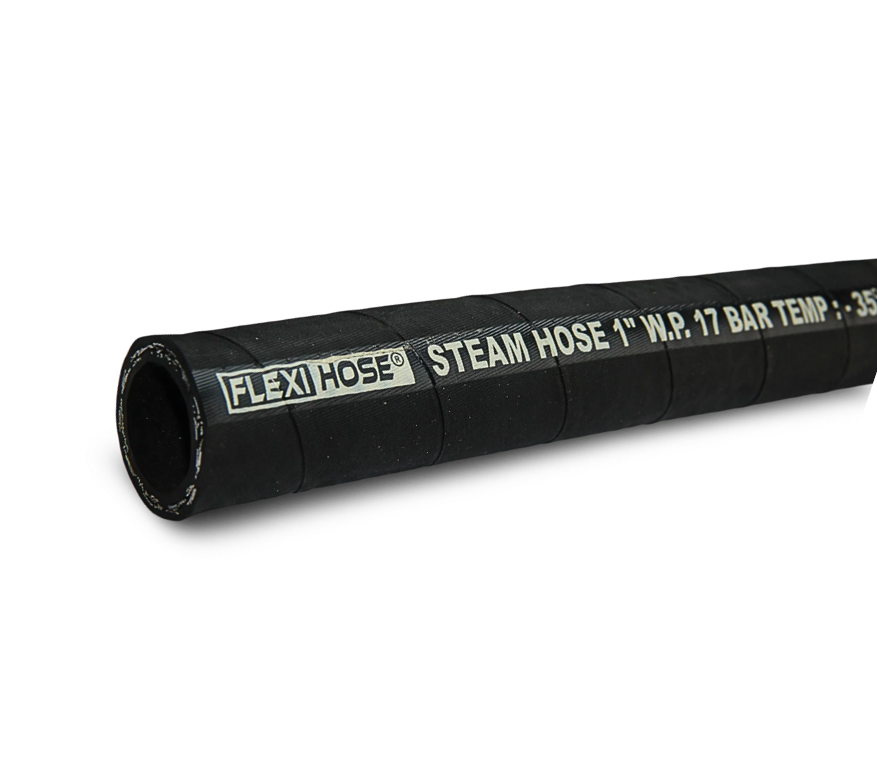
Jump to the full Type 2 size table

Type 3, two wire braid

Exceeds IS 10655 Type 3

FLEXI HOSE rubber steam hose, type 3, two wire braid, EPDM tube and cover, working pressure 250 PSI / 17 BAR, manufactured at Bhiwadi Rajasthan
  • Working pressure250 PSI / 17 BAR
  • Burst pressure, min.2500 PSI / 170 BAR
  • Service temperature−40 C to +232 C
  • Bore range1/2″ to 1-1/4″ (12.50 to 31.00 mm)
  • Reinforcementdouble braid of brass-coated steel wire

The high pressure and high temperature grade. A second braid of the same wire takes working pressure to 250 PSI / 17 BAR and service temperature to +232 C. Catalogued to 1-1/4″.

Jump to the full Type 3 size table

The two grades side by side. Every figure is the catalogue's own printed pair.
 Type 2, one wire braidType 3, two wire braid
StandardExceeds IS 10655 Type 2Exceeds IS 10655 Type 3
BIS licenceNoneNone
TubeHeat-resistant EPDMHeat-resistant EPDM
ReinforcementOne braid, brass-coated steel wireTwo braids, brass-coated steel wire
CoverEPDM, heat, ageing and ozone resistantEPDM, heat, ageing and ozone resistant
Working pressure145 PSI / 10 BAR250 PSI / 17 BAR
Burst pressure, min.1450 PSI / 100 BAR2500 PSI / 170 BAR
Service temperature−40 C to +195 C−40 C to +232 C
Bore range1/2″ to 2″ (12.50 to 50.00 mm)1/2″ to 1-1/4″ (12.50 to 31.00 mm)
Mean O.D. range21.50 to 64.50 mm24.00 to 45.00 mm
Sizes cataloguedSixFour
Working pressure against minimum burst pressure, both grades Type 2 working pressure is 145 PSI / 10 BAR against a minimum burst of 1450 PSI / 100 BAR. Type 3 working pressure is 250 PSI / 17 BAR against a minimum burst of 2500 PSI / 170 BAR. Bar length is proportional to PSI. Type 2 working 145 PSI / 10 BAR Type 2 burst, min. 1450 PSI / 100 BAR Type 3 working 250 PSI / 17 BAR Type 3 burst, min. 2500 PSI / 170 BAR Bar length is proportional to PSI. Every figure is the catalogue's own printed pair and is not converted.
Working against minimum burst pressure. Both grades hold the same figures across every bore in their range.
Service temperature bands, both grades Type 2, one wire braid, is rated from -40 degrees Celsius to +195 degrees Celsius. Type 3, two wire braid, is rated from -40 degrees Celsius to +232 degrees Celsius. Both bands start at -40 degrees Celsius.Type 2, one wire braid +195 C Type 3, two wire braid +232 C -50050100150200250 Service temperature, degrees Celsius −40 C
Both grades start at −40 C. The two wire braid grade carries the higher ceiling at the top of the band.

How it is built

Three layers, and each one is doing a specific job. The construction is the same on both grades apart from the number of braids.

Tube

Heat-resistant EPDM rubber compound. EPDM is used because it holds its strength and flexibility in saturated steam and in the condensate that forms with it. Natural rubber and nitrile harden and craze on the same duty.

Reinforcement

High-tensile brass-coated steel wire, one braid on the Type 2 grade and two on the Type 3. The brass coating bonds the wire to the rubber, which is what stops the braid separating from the wall through repeated heat cycling.

Cover

EPDM rubber compound resistant to heat, ageing and ozone. The same compound family as the tube, so the wall is protected from the steam inside and the plant environment outside.

The wall in section, one wire braid

Cutaway of the hose wall The wall in section, peeled back from the left: the bore, then the tube (heat-resistant EPDM rubber compound), then the reinforcement (one braid of high-tensile brass-coated steel wire), then the cover (EPDM rubber compound resistant to heat, ageing and ozone). 1 2 3 Bore
  1. 1Tubeheat-resistant EPDM rubber compound
  2. 2Reinforcementone braid of high-tensile brass-coated steel wire
  3. 3CoverEPDM rubber compound resistant to heat, ageing and ozone
The wall in section, peeled back from the left. Drawn to show layer order, not to scale.

The wall in section, two wire braid

Cutaway of the hose wall The wall in section, peeled back from the left: the bore, then the tube (heat-resistant EPDM rubber compound), then the reinforcement (two braids of high-tensile brass-coated steel wire), then the cover (EPDM rubber compound resistant to heat, ageing and ozone). 1 2 3 Bore
  1. 1Tubeheat-resistant EPDM rubber compound
  2. 2Reinforcementtwo braids of high-tensile brass-coated steel wire
  3. 3CoverEPDM rubber compound resistant to heat, ageing and ozone
The wall in section, peeled back from the left. Drawn to show layer order, not to scale.

Specification tables

Every figure below is transcribed from the FLEXI HOSE Product Catalogue 2026-2027. PSI and BAR are the catalogue's own printed pairs and are not converted. Working pressure and minimum burst pressure are constant across every bore within a grade. The mean outside diameter is the figure your coupling and clamp have to match, which is why it is published for every size.

Type 2, one wire braid, Exceeds IS 10655 Type 2

Steam hose, one wire braid. Exceeds IS 10655 Type 2. Service temperature −40 C to +195 C.
Bore (in)Bore (mm)Mean O.D. (mm)WP (PSI)WP (BAR)Burst, min. (PSI)Burst, min. (BAR)
1/2″12.5021.50145101450100
3/4″20.0029.00145101450100
1″25.0035.50145101450100
1-1/4″31.0042.50145101450100
1-1/2″38.0050.50145101450100
2″50.0064.50145101450100

Six bores. Coil and cut lengths are not printed in the catalogue for this grade, so we do not publish a figure. Ask us for the standard coil and for any cut length you need.

Size ladder of the six catalogued bores of the one wire braid grade Six rings drawn to relative scale. Nominal bore, bore in millimetres, mean outside diameter in millimetres: 1/2 inch, 12.50, 21.50. 3/4 inch, 20.00, 29.00. 1 inch, 25.00, 35.50. 1-1/4 inch, 31.00, 42.50. 1-1/2 inch, 38.00, 50.50. 2 inch, 50.00, 64.50. 1/2″ 12.50 / 21.50 mm 3/4″ 20.00 / 29.00 mm 1″ 25.00 / 35.50 mm 1-1/4″ 31.00 / 42.50 mm 1-1/2″ 38.00 / 50.50 mm 2″ 50.00 / 64.50 mm Bore and mean outside diameter in millimetres, drawn to relative scale.
Six catalogued bores of the one wire braid grade, drawn to relative scale. Mean outside diameter decides the clamp and the coupling.

Type 3, two wire braid, Exceeds IS 10655 Type 3

Steam hose, two wire braid. Exceeds IS 10655 Type 3. Service temperature −40 C to +232 C.
Bore (in)Bore (mm)Mean O.D. (mm)WP (PSI)WP (BAR)Burst, min. (PSI)Burst, min. (BAR)
1/2″12.5024.00250172500170
3/4″20.0031.00250172500170
1″25.0038.00250172500170
1-1/4″31.0045.00250172500170

Four bores. The catalogue lists this grade only to 1-1/4″. We do not quote a pressure for 1-1/2″ or 2″ at 17 BAR, and we will not tell you those sizes cannot be made either. Ask, and we will answer from the works.

Saturated and superheated steam, and why it changes the grade

Saturated steam sits at the boiling point for its pressure. Raise the pressure and the temperature rises with it, and any heat lost turns some of the steam back into water. That condensate is what a steam hose actually spends most of its life carrying, and it is the reason the tube has to be EPDM: hot water and hot steam attack a rubber compound differently, and EPDM survives both.

Superheated steam has been heated past its saturation point, so it is hotter than the pressure alone would suggest. This is where the two grades separate. A line at 10 BAR carrying saturated steam sits inside the one wire braid grade's +195 C band. The same 10 BAR line carrying superheated steam can run hotter than that, and then the grade is decided by temperature and not by pressure. Read both numbers off the plane above, and specify on whichever one pushes you higher.

Where the hose runs a condensate return rather than live steam, tell us: the pressure is usually lower and the duty is continuous hot water, which is a different conversation from intermittent live steam.

How to specify a steam hose in five lines

Send these five and we can come back the same working day. Four of the five are numbers you can read off the plant.

  1. BoreIn inches or millimetres. If you are replacing an existing hose, measure the inside diameter, not the outside.
  2. Pressure at the hoseNot the boiler pressure. The pressure where the hose actually sits, after any reducing station.
  3. Temperature at the hoseAnd whether the steam is saturated or superheated. This is the line most enquiries leave out and the one that decides the grade.
  4. Length and quantityTotal metres, and how many lengths. Say if you need them cut to a fixed length.
  5. Ends and delivery cityCoupling type, whether you want ends fitted and crimped, and where it is going.

If your duty falls outside the published range, say so. Above 250 PSI / 17 BAR, above +232 C, or on hot oil or thermal fluid rather than steam, we do not have a published rubber grade and we will tell you that rather than sell you the nearest thing. In several of those cases the answer is stainless steel flexible hose.

Couplings and fittings for steam hose

Use interlocking or crimped steam couplings that grip the wire reinforcement, sized to the hose's mean outside diameter. That is the figure in the third column of both tables above, and it is why we publish it.

A worm-drive clamp on a barbed tail is not a steam fitting. The wall expands when the line comes up to temperature and contracts when it cools, and a screw clamp does not follow it. After enough cycles the clamp is loose and the joint weeps, then blows. The failure is at the coupling far more often than in the hose.

Tell us the bore, the coupling standard you work to and whether you want ends fitted, and we will supply the made-up assembly rather than the hose alone. Assemblies are pressure tested before dispatch.

What steam hose is not rated for

Naming the limit is part of specifying correctly. If your duty sits outside any of these, say so when you enquire and we will point you at the right product or tell you we do not have one.

  • Exceeds the standard rather than conforming to it. Both grades exceed IS 10655, Type 2 and Type 3 respectively. Neither carries a CM/L number and neither may be called certified or conforming. If a tender requires a licensed steam grade, we do not hold one.
  • The one wire braid grade is not rated above 145 PSI / 10 BAR or +195 C. Above either figure, specify the two wire braid grade.
  • The two wire braid grade is not rated above 250 PSI / 17 BAR or +232 C. Above either figure we have no published rubber grade. Ask before ordering.
  • The two wire braid grade is not catalogued above 1-1/4″. For 1-1/2″ and 2″ the published grade is the one wire braid at 145 PSI / 10 BAR.
  • Not a hot oil or thermal fluid hose. Mineral oils and thermal transfer fluids attack EPDM. Tell us the medium, not just the temperature.
  • Not a food or pharmaceutical grade by default. The catalogue does not publish a food-contact grade in this family. Do not assume a clean-in-place duty is covered.
  • Not a run-to-failure item. Steam hose is inspected and replaced on a schedule. A burst at +195 C is an injury, not a downtime event.
  • Not a fixed steam main. Flexible hose is for connections that move, flex or disconnect. A fixed run should be rigid pipe.

Inspection and replacement

What to look for, and what means stop using it now.

Before each shift

Walk the hose cold. Look for cover cracking, blistering, a soft or swollen spot, and any staining or weeping at either coupling.

Take it out of service if

The cover is cracked through, there is a soft spot or bulge anywhere in the length, wire is visible or rusting, or a coupling weeps under pressure. None of these are watch-and-see conditions on a steam line.

Replace on schedule

Set the interval from your own duty and cycle count and hold to it. Steam hose is a consumable safety item and the replacement length costs less than the incident.

Where steam hose is used

Applications named in the FLEXI HOSE catalogue for these two grades, industry by industry. We list what the catalogue lists.

Refineries

Steam lancing, tracing, thawing and process heating on refinery and petrochemical duty.

Shipyards

Deck, dock and yard steam services where a rigid line cannot reach.

Chemical plants

Process steam, reactor and vessel cleaning, jacket heating.

Steel mills

Steam service around hot mill and rolling equipment.

Foundries

Steam supply and cleaning around melting and casting lines.

Heavy industry

General plant steam duty wherever a flexible connection is required.

Which pipe for a steam line

Rubber steam hose is one answer of four, and it is not always the right one. Here is how the choice usually falls.

  • A fixed steam main

    Rigid pipe, normally carbon steel, sized and supported by your own piping standard. A flexible hose is not a substitute for a fixed run.

  • A connection that moves, flexes or disconnects

    Rubber steam hose, which is this page. Steam lances, jacket feeds, tank cleaning points, machines that vibrate, temporary connections.

  • Above +232 C, or where rubber will not do

    Stainless steel flexible hose. Metal corrugated construction for high temperature, high pressure and corrosive media.

  • Where the liner must be chemically inert

    PTFE hose, for aggressive chemical service alongside heat.

  • Hot water rather than steam

    Tell us. The duty is continuous rather than cyclic and the pressure is usually lower, so the right grade may not be a steam grade at all.

Made at one works, supplied across India

One factory, no trading

Compounding, braiding, extrusion and curing all happen at F-621, Phase-1, RIICO Industrial Area, Bhiwadi 301019, Rajasthan. In the hose industry since 1980, manufacturing since 1993. Every metre is made at our own plant.

Ten tests in our own laboratory

Tensile strength, elongation, ageing, specific gravity, hydrostatic pressure, dimensional, chemical resistance, melting temperature, ash content and rheometer. All testing equipment is calibrated by NABL accredited bodies. Batch test reports are available with an order.

Domestic dispatch

Despatch across India, including Delhi-NCR, Mumbai, Pune, Chennai, Ahmedabad, Kolkata, Hyderabad and Bengaluru. Most sizes are held in stock for fast dispatch. Tell us the delivery city and we will confirm the lead time with the quote.

Production lead time is confirmed with every quote as a range in working days from order confirmation, depending on size and quantity. We do not publish a single figure.

Tell us the duty. We will spec it and quote it.

Send these five things and we can come back the same working day.

  1. Bore size, in inches or millimetres
  2. Steam pressure at the hose, in PSI or BAR
  3. Steam temperature at the hose, and saturated or superheated
  4. Total length in metres and the number of lengths
  5. Coupling type, whether ends are fitted, and the delivery city
  1. You send the five lines
  2. We confirm the grade, the size and the quantity
  3. You get a written quote the same working day

Send the pressure and the temperature at the hose and we will tell you which of the two grades is the right one, or that neither is.

Questions about steam hose

What is a steam hose?

A steam hose is a flexible rubber hose built to carry saturated or superheated steam under pressure. It differs from a water or air hose in three ways: the tube and cover are heat-resistant EPDM rather than natural rubber or nitrile, the reinforcement is steel wire rather than textile yarn, and the burst margin is far wider. Our one wire braid grade holds 145 PSI / 10 BAR against a minimum burst of 1450 PSI / 100 BAR.

What are the different types of steam hose?

Flexihose publishes two grades. The one wire braid grade exceeds IS 10655 Type 2 and is rated 145 PSI / 10 BAR with a service band of −40 C to +195 C, in bores from 1/2″ to 2″ (12.50 to 50.00 mm). The two wire braid grade exceeds IS 10655 Type 3 and is rated 250 PSI / 17 BAR with a service band of −40 C to +232 C, in bores from 1/2″ to 1-1/4″ (12.50 to 31.00 mm). The difference in the wall is the second braid of brass-coated steel wire.

What is the working pressure of a steam hose?

Ours is 145 PSI / 10 BAR for the one wire braid grade and 250 PSI / 17 BAR for the two wire braid grade. The figure does not change with bore: every size in each range carries the same working pressure and the same minimum burst pressure. Steam hose is published at a wide range of pressures across the market, so always specify by the grade, not by the family.

Which pipe is used for a steam line?

A fixed steam main is rigid pipe, normally carbon steel. Flexible hose is used where the connection has to move, flex or be disconnected: a steam lance, a jacket feed, a tank cleaning point, a machine that vibrates. If your duty needs a metal flexible connection rather than rubber, our stainless steel flexible hose is the right family. If it needs a chemically inert liner, look at PTFE hose.

What temperature can a steam hose take?

The one wire braid grade is rated −40 C to +195 C. The two wire braid grade is rated −40 C to +232 C. These are service temperatures, not spot maxima, and they are the figures printed in the FLEXI HOSE catalogue. If your line runs above +232 C, we do not have a published rubber grade for it. Tell us the duty and we will say so rather than sell you the nearest thing.

Is Flexihose steam hose BIS certified?

No. Both steam grades exceed IS 10655, which means they are built past the standard's requirement, but neither carries a BIS licence and neither may be described as conforming or certified. The only BIS-licensed products we make are Water Hose Type 2 under IS 444-2017 and Air Hose Type 1 and Type 2 under IS 446-2017, and the licence numbers are published on those pages, not on this one. If a tender demands a licensed steam grade, we will tell you we do not hold one.

Why is EPDM used for steam hose?

EPDM keeps its strength and flexibility in saturated steam and in the condensate that forms with it. Natural rubber and nitrile harden, craze and fail quickly on the same duty. Both the tube and the cover of our steam hose are heat-resistant EPDM, so the wall is protected from the steam inside and from heat, ageing and ozone outside.

Why is the reinforcing wire brass-coated?

The brass coating is what bonds the steel wire to the rubber. Without it the wire and the compound separate under repeated heating and cooling, the braid loses its grip on the wall, and the hose fails at the reinforcement rather than at the tube. Both our grades use high-tensile brass-coated steel wire, one braid on the Type 2 grade and two on the Type 3.

What sizes does steam hose come in?

The one wire braid grade is catalogued in six bores: 1/2″ (12.50 mm), 3/4″ (20.00 mm), 1″ (25.00 mm), 1-1/4″ (31.00 mm), 1-1/2″ (38.00 mm) and 2″ (50.00 mm), with mean outside diameters from 21.50 mm to 64.50 mm. The two wire braid grade is catalogued in four: 1/2″, 3/4″, 1″ and 1-1/4″, with mean outside diameters from 24.00 mm to 45.00 mm.

Do you make 1-1/2 inch or 2 inch steam hose at 17 BAR?

Those sizes are not in the published catalogue for the two wire braid grade, which is listed to 1-1/4″. We will not quote a pressure for a size the catalogue does not print, and we will not tell you it cannot be made either. Ask us and we will come back with an answer from the works.

What fittings are used on a steam hose?

Interlocking or crimped steam couplings that grip the wire reinforcement, fitted to the hose's mean outside diameter. A worm-drive clamp on a barbed tail is not a steam fitting: it relaxes as the wall expands and contracts through every heat cycle. Tell us the bore, the coupling standard and whether you want ends fitted, and we will supply the assembly rather than the hose alone.

The mean outside diameter in the tables above is the figure your coupling has to match, which is why we publish it for every size.

How often should a steam hose be replaced?

On the schedule your own maintenance regime sets, and immediately on any cover crack, blister, soft spot or weeping at a coupling. Steam hose is not run to failure. A burst steam line at +195 C is an injury, not a downtime event, and the cost of a replacement length is not comparable.

Is this the hose for a steam iron or a garment steamer?

No. This is industrial rubber steam hose in bores from 1/2″ to 2″ for plant duty. A steam iron or garment steamer uses a light silicone or PTFE tube of a few millimetres bore, sold as an appliance spare. We do not make those.

Do you supply test reports with steam hose?

Yes. Our own laboratory runs tensile strength, elongation, ageing, specific gravity, hydrostatic pressure, dimensional, chemical resistance, melting temperature, ash content and rheometer tests, and all testing equipment is calibrated by NABL accredited bodies. Batch test reports are available with an order. Ask for them when you place it.

Specifications on this page are transcribed from the FLEXI HOSE Product Catalogue 2026-2027. Last reviewed 10 September 2026. Standards referenced: Bureau of Indian Standards and the ISO standards catalogue.

Back to top