
Sand Blasting Hose Manufacturer in India
Braided, abrasion-resistant hose for blasting cast metal, stone and concrete with sand, shot or grit — wet or dry. Made at Bhiwadi, Rajasthan.
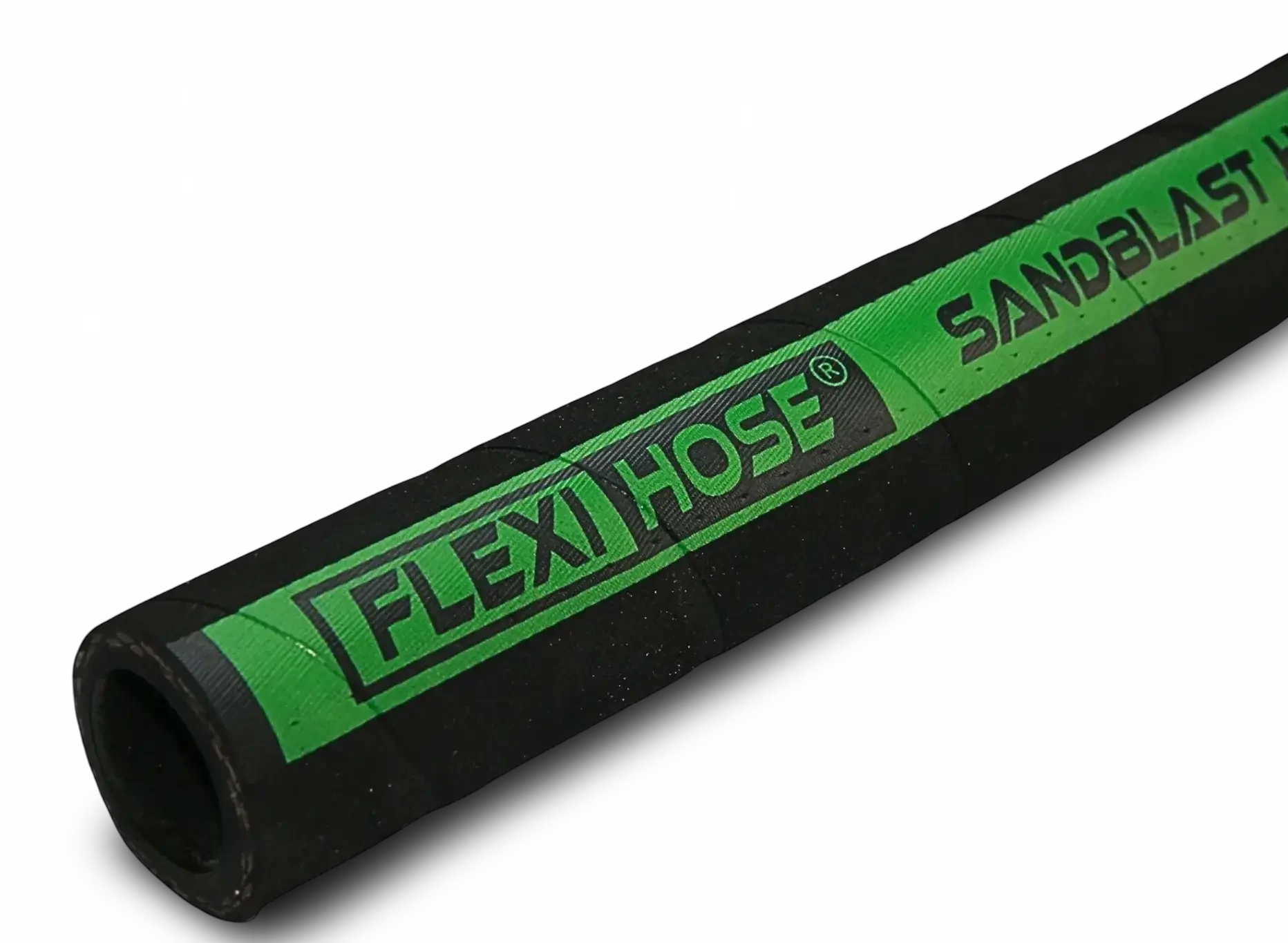
The same hose, under eight names
Buyers use all of these names for one product: an abrasion-resistant rubber hose that carries sand, steel shot, grit or garnet from a blast pot to the nozzle.
Flexihose makes the braided grade: exceeds IS 5894, rated 175 PSI / 12 BAR, DIN abrasion loss below 60 mm³.
What a sand blasting hose is
A heavy-duty rubber hose built for abrasive media moving at speed. Sand and grit wear the inside of the hose, so the lining does the work. It has three layers: an extra-thick seamless rubber lining free of mineral filler, a high-tenacity synthetic yarn braid, and a cover that resists abrasion, ozone and weather. Not sure which abrasive fits your job? See our sand, shot and grit comparison guide.
Flexihose has been in the hose industry since 1980 and manufacturing since 1993, at a manufacturing unit in Bhiwadi, Rajasthan. Blast hose is supplied across India and to export markets in the GCC.
Three layers, one job
Blast hose wears from the inside out. Everything about the construction is arranged around keeping the lining alive. See where this hose sits among the parts of a blast line, from compressor to nozzle.
Lining
Extra-thick seamless rubber, free from mineral filler. DIN abrasion loss below 60 mm³ — the figure that decides how long the hose lasts.
Reinforcement
Single or double braid of high-tenacity synthetic yarn, with a copper element that keeps static from building up. Asked for in the trade as 1-ply and 2-ply.
Cover
Rubber compound highly resistant to abrasion, ozone and weather, for hose that is dragged across site and left outdoors.
Specification
Working and burst pressure are constant across the range. Figures are as printed in the FLEXI HOSE catalogue and are not converted.
| Bore | Bore (mm) | Mean O.D. (mm) | Working pressure | Burst pressure |
|---|---|---|---|---|
| 1/2″ | 12.00 | 27.00 | 175 PSI / 12 BAR | 700 PSI / 48 BAR |
| 3/4″ | 20.00 | 33.00 | 175 PSI / 12 BAR | 700 PSI / 48 BAR |
| 1″ | 25.00 | 39.00 | 175 PSI / 12 BAR | 700 PSI / 48 BAR |
| 1-1/4″ | 31.00 | 48.00 | 175 PSI / 12 BAR | 700 PSI / 48 BAR |
| 1-1/2″ | 38.00 | 54.00 | 175 PSI / 12 BAR | 700 PSI / 48 BAR |
| 2″ | 50.00 | 70.00 | 175 PSI / 12 BAR | 700 PSI / 48 BAR |
Service temperature −40 °C to +75 °C. Coil lengths on request.
Sizing the hose to your nozzle
The commonest specifying mistake is choosing bore by what is in stock rather than by what the nozzle needs.
Start at the nozzle, not the hose
The nozzle orifice sets the air volume the system has to deliver. The hose only has to carry that volume without throttling it.
Take bore at three to four times the orifice
Undersized hose starves the nozzle. Pressure drops at the workface, the abrasive slows, and the operator blasts longer to do the same work while the hose wears faster.
Check the compressor before you size up
If the compressor cannot hold the nozzle’s CFM demand at working pressure, a larger hose will not rescue it. For the full sizing chain from nozzle to compressor, see our compressor and nozzle sizing guide.
Keep the line short and straight
Every metre and every tight bend costs pressure. Bends are also where the cover wears through first.
| Nozzle orifice | Suggested hose bore |
|---|---|
| 3/16″ (5 mm) | 3/4″ (20 mm) |
| 1/4″ (6 mm) | 3/4″ to 1″ (20–25 mm) |
| 5/16″ (8 mm) | 1″ to 1-1/4″ (25–31 mm) |
| 3/8″ (10 mm) | 1-1/4″ to 1-1/2″ (31–38 mm) |
| 1/2″ (12 mm) | 1-1/2″ to 2″ (38–50 mm) |
Send us your nozzle orifice size, compressor output in CFM, blast pressure and the length you need, and we will come back with a bore and a coil length.
Static build-up in blast lines
Why it happens
Abrasive travelling at velocity through a rubber bore generates static charge. On a long line the charge accumulates, and it is a real hazard around the nozzle and the operator.
How it is controlled
This hose has a copper element built into it that reduces static build-up along the line.
It is still good practice to bond and earth the whole assembly — pot and nozzle holder — the way any blast line should be set up. The copper element is what stops charge accumulating in the hose itself.
What this hose is not rated for
Being straight about the limits is part of specifying correctly.
- Not for high-pressure water jetting. This is a dry- and wet-abrasive media hose. Hydro-blast and water-jetting duty needs a different construction entirely.
- Not BIS licensed. This hose exceeds IS 5894; it does not carry a BIS licence and we do not describe it as BIS certified. Our three BIS-licensed products are Water Hose Type 2 and Air Hose Type 1 and Type 2.
- Not rated above +75 °C or below −40 °C. Outside that band, ask us before ordering.
- Not the 10-bar textile-ply blast grade. We make a second blast hose on a different construction and a different duty. If your machine is specified at 10 bar, tell us — this is not the one you want.
Where it is used
Shipbuilding and repair
Hull de-rusting and surface preparation before protective coating, in yards and dry docks.
Steel fabrication
Removing mill scale and weld spatter from plate and structural sections before painting.
Foundries and casting
Cleaning sand and flash from castings, the duty IS 5894 hose is written for.
Oil and gas
Maintenance blasting of tanks, pipework and structures during shutdowns.
Stone and concrete
Surface profiling and cleaning of stone, concrete and masonry.
Construction and infrastructure
Preparing bridges, dams and industrial structures for protective coatings.
Guides to the work this hose does: the sand blasting process from inspection to coating, the blasting and painting procedure with a method statement structure, the Sa 2.5 surface preparation standard most coating specifications call for, and what the Factories Rules say about silica sand as a blasting abrasive. Job-specific guides cover granite sand blasting and sand blasting concrete, and there is a guide to choosing the blasting media that goes down this hose.
Supplied across India, from one manufacturing unit
Every metre of Flexihose blast hose is made at our own manufacturing unit at Bhiwadi, Rajasthan, and dispatched from there. There is no reseller in the middle and no imported stock being relabelled — you are buying from the manufacturer.
We supply blast hose to buyers throughout India, including the industrial belts around Delhi-NCR, Mumbai and Pune, Ahmedabad and the wider Gujarat corridor, Chennai, Kolkata, Hyderabad, Bengaluru, Jaipur and Ludhiana — and to export markets across the GCC. Tell us your delivery city with your enquiry and we will confirm despatch and freight with the quote.
Made at Bhiwadi
A manufacturing unit in the RIICO industrial area, Rajasthan. In the hose industry since 1980, manufacturing since 1993.
Cut to your length
Supplied in coils, or cut to the length you need.
Export as well as domestic
Blast hose ships to the GCC alongside domestic orders, with the export documentation buyers there ask for.
Why buy sand blast hose from Flexihose
What plant engineers and procurement teams check for before they order.
Abrasion-resistant lining
Extra-thick, seamless rubber, free from mineral filler. DIN abrasion loss below 60 mm³ — the figure that decides how long the hose lasts.
Copper element that reduces static build-up
Built into the reinforcement, not an accessory. It reduces static build-up along the line.
−40 °C to +75 °C service range
Rated for a wide service temperature band, suited to blasting work across most Indian and GCC industrial sites.
One manufacturing unit, no middleman
Every metre is made at our own manufacturing unit in Bhiwadi, Rajasthan — no reseller in between and no imported stock being relabelled.
Every batch tested in-house
Tensile strength, elongation, ageing, specific gravity, hydrostatic pressure, dimensional, chemical resistance, melting temperature, ash content and rheometer. All testing equipment is calibrated by NABL accredited bodies.
In the hose industry since 1980
Manufacturing since 1993. Vardhman Hydraulic Hoses Pvt. Ltd. has been building the abrasive-blasting duty into its rubber compounds for three decades.
Tell us the duty. We will spec it and quote it.
Send these four things and we can come back the same working day with a bore, a coil length and a price.
- Bore size, or your nozzle orifice if you are unsure
- Total length in metres
- Quantity
- Delivery city
Not sure which grade you need? Send the machine make and blast pressure and we will tell you whether this hose or the 10-bar grade is the right one.
What buyers say
Feedback received from customers by WhatsApp and email, shown with their agreement.
We purchased the FLEXIHOSE Sandblast Hose for our abrasive blasting requirements and have been quite satisfied with its performance. The hose feels durable, has good flexibility, and handles the working conditions well. The overall build quality is impressive for industrial use. Good product and professional service from FLEXIHOSE.
Good quality industrial hoses from FLEXIHOSE. We have used their Sandblast, Steam and Hydraulic Hoses for different applications and found the products reliable and well-finished. The team is also responsive and professional. Overall, a good experience dealing with FLEXIHOSE.
Frequently asked questions
Sand blast hose specification, static build-up and supply — the questions buyers send us most.
What are the specifications of sand blasting hoses?
Flexihose sand blasting hose exceeds IS 5894. Working pressure is 175 PSI / 12 BAR with a burst pressure of 700 PSI / 48 BAR across every size, service temperature runs from −40 °C to +75 °C, and DIN abrasion loss is below 60 mm³. Bore sizes run from 1/2″ (12 mm) to 2″ (50 mm), with mean outside diameters from 27 mm to 70 mm.
What size air hose for a sand blaster?
Size the hose from the nozzle, not from stock. Take a bore roughly three to four times the nozzle orifice — a 1/4″ (6 mm) nozzle wants around a 3/4″ to 1″ bore, and a 3/8″ (10 mm) nozzle wants around 1-1/4″ to 1-1/2″. Undersized hose starves the nozzle and drops pressure at the workface. Check the compressor can hold the nozzle’s CFM demand before increasing hose size.
What is the purpose of sand blasting?
Sand blasting drives abrasive media at high velocity against a surface to strip rust, scale, old paint and mill finish, and to profile the surface so a protective coating bonds properly. It is standard practice in shipbuilding, steel fabrication, foundry cleaning, oil and gas maintenance, and concrete surface preparation.
Which material is used for sand blasting hose?
An extra-thick seamless rubber lining, free from mineral filler, with a DIN abrasion loss below 60 mm³. Reinforcement is a single or double braid of high-tenacity synthetic yarn with a copper element that reduces static build-up, and the cover is a rubber compound resistant to abrasion, ozone and weather.
What is the burst pressure of a sand blasting hose?
700 PSI / 48 BAR across the full bore range, against a working pressure of 175 PSI / 12 BAR.
What bore sizes does Flexihose sand blast hose come in?
Six bores: 1/2″ (12 mm), 3/4″ (20 mm), 1″ (25 mm), 1-1/4″ (31 mm), 1-1/2″ (38 mm) and 2″ (50 mm), with mean outside diameters from 27 mm to 70 mm.
What is the DIN abrasion loss rating of this hose?
Below 60 mm³. That figure comes from the extra-thick, seamless rubber lining, free from mineral filler, and is the number that decides how long the hose lasts under abrasive wear.
How do I know when to replace a blast hose?
Replace it when the cover cracks or splits, when a soft spot or bulge appears, or when wall thickness has worn down — usually first at the bends, where the hose flexes most. Blast hose is not run to failure; a burst under pressure with abrasive in the line is dangerous.
What is the difference between blast hose and air hose?
Air hose carries compressed air only. Blast hose carries air with abrasive in it, so it is built with a much thicker abrasion-resistant lining. Using air hose for blasting wears it through quickly and is not safe.
Is Flexihose sand blast hose static conductive?
This grade includes a copper element built into the reinforcement that reduces static build-up along the line. It is still good practice to bond and earth the pot and nozzle holder as well.
Do you supply sand blast hose with couplings fitted?
No. This grade is supplied as bare hose, cut to length or in coils. We do not fit couplings to sand blast hose.
Who manufactures sand blast hose in India?
Flexihose India (Vardhman Hydraulic Hoses Pvt. Ltd.) manufactures sand blast hose at a single manufacturing unit in Bhiwadi, Rajasthan — in the hose industry since 1980, manufacturing since 1993.
Do you export sand blast hose to the GCC?
Yes. Flexihose supplies sand blast hose across India and to export markets across the GCC, with the export documentation — commercial invoice, packing list, certificate of origin, bill of lading and test certificates — buyers there ask for.
What is this sand blast hose not rated for?
High-pressure water jetting, use above +75 °C or below −40 °C, and it is not BIS licensed — it exceeds IS 5894 without a licence. It is also not the 10-bar textile-ply blast grade, which is a different product for a different duty.
Other hose families we manufacture
Four product families, one manufacturer — all made in-house at Bhiwadi, Rajasthan.
Hydraulic hoses
SAE 100 and EN 856 series hydraulic hoses for high-pressure circuits in construction, agriculture and industrial machinery.
View all hydraulic hoses →Industrial rubber hoses
Air, steam, carbon-free and water hoses alongside this sand blast grade — manufactured to IS and international standards.
View all industrial hoses →Suction & discharge hoses
Water suction, oil suction, fly ash and UHMWPE chemical hoses for transfer and discharge applications across industries.
View suction & discharge range →SS flexible hoses
Stainless steel corrugated flexible hoses for high-temperature, high-pressure and corrosive-media applications, manufactured to EN ISO 10380.