
Steam Hose Supplier in the United Arab Emirates, Exceeds IS 10655 Type 2 and Type 3
Industrial rubber steam hose with a heat-resistant EPDM tube and cover and brass-coated steel wire braid. Bores 1/2″ to 2″ (12.50 to 50.00 mm) at 145 PSI / 10 BAR, and 1/2″ to 1-1/4″ at 250 PSI / 17 BAR. Service to +195 C and +232 C. Made at our own works in Bhiwadi, India and shipped to the United Arab Emirates from Nhava Sheva (JNPT) and Mundra.
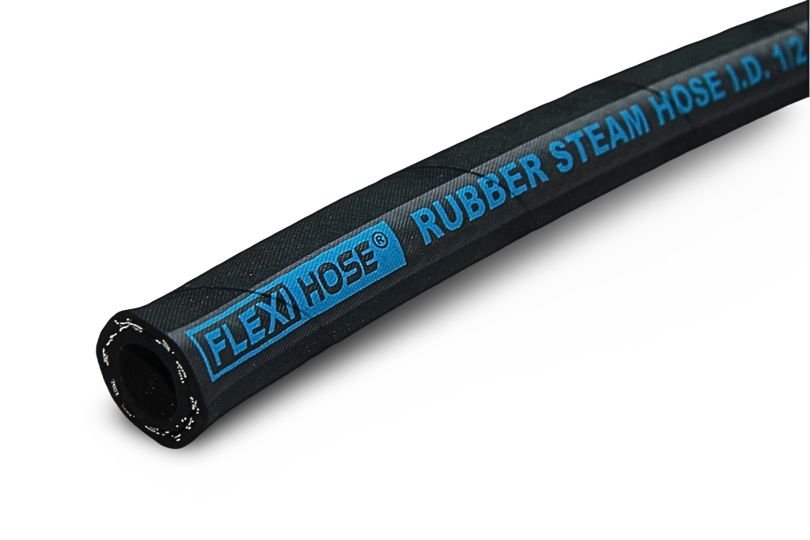
What an industrial steam hose is
A steam hose is a flexible rubber hose built to carry saturated or superheated steam under pressure. Flexihose makes two grades, both with a heat-resistant EPDM tube and cover and a braid of high-tensile brass-coated steel wire.
One wire braid: exceeds IS 10655 Type 2. 145 PSI / 10 BAR working, 1450 PSI / 100 BAR minimum burst, −40 C to +195 C, bore 1/2″ to 2″ (12.50 to 50.00 mm).
Two wire braid: exceeds IS 10655 Type 3. 250 PSI / 17 BAR working, 2500 PSI / 170 BAR minimum burst, −40 C to +232 C, bore 1/2″ to 1-1/4″ (12.50 to 31.00 mm).
Neither grade holds a BIS licence. Both exceed IS 10655 rather than conform to it, and we do not describe either as certified or compliant.
The two grades, and which one you need
Two numbers decide it: the pressure at the hose and the temperature at the hose. Specify on whichever pushes you higher.
| Type 2, one wire braid | Type 3, two wire braid | |
|---|---|---|
| Standard | Exceeds IS 10655 Type 2 | Exceeds IS 10655 Type 3 |
| BIS licence | None | None |
| Tube and cover | Heat-resistant EPDM | Heat-resistant EPDM |
| Reinforcement | One braid, brass-coated steel wire | Two braids, brass-coated steel wire |
| Working pressure | 145 PSI / 10 BAR | 250 PSI / 17 BAR |
| Burst, minimum | 1450 PSI / 100 BAR | 2500 PSI / 170 BAR |
| Service temperature | −40 C to +195 C | −40 C to +232 C |
| Bore range | 1/2″ to 2″ | 1/2″ to 1-1/4″ |
| Sizes catalogued | Six | Four |
How it is built
Tube
Heat-resistant EPDM. EPDM holds its properties in saturated steam and in the condensate that forms with it, where natural rubber and nitrile harden and craze.
Reinforcement
High-tensile brass-coated steel wire, one braid on Type 2 and two on Type 3. The brass coating bonds the wire to the rubber, which is what stops the braid separating from the wall through repeated heat cycling.
Cover
EPDM resistant to heat, ageing and ozone. The same compound family as the tube.
- 1Tubeheat-resistant EPDM rubber compound
- 2Reinforcementone braid of high-tensile brass-coated steel wire
- 3CoverEPDM rubber compound resistant to heat, ageing and ozone
Specification tables
Every figure is transcribed from the FLEXI HOSE Product Catalogue 2026-2027. PSI and BAR are the catalogue's own printed pairs and are not converted. The mean outside diameter is the figure your coupling and clamp have to match, which is why it is published for every size.
Type 2, one wire braid, Exceeds IS 10655 Type 2
| Bore (in) | Bore (mm) | Mean O.D. (mm) | WP (PSI) | WP (BAR) | Burst, min. (PSI) | Burst, min. (BAR) |
|---|---|---|---|---|---|---|
| 1/2″ | 12.50 | 21.50 | 145 | 10 | 1450 | 100 |
| 3/4″ | 20.00 | 29.00 | 145 | 10 | 1450 | 100 |
| 1″ | 25.00 | 35.50 | 145 | 10 | 1450 | 100 |
| 1-1/4″ | 31.00 | 42.50 | 145 | 10 | 1450 | 100 |
| 1-1/2″ | 38.00 | 50.50 | 145 | 10 | 1450 | 100 |
| 2″ | 50.00 | 64.50 | 145 | 10 | 1450 | 100 |
Six bores. Coil and cut lengths are not printed in the catalogue for this grade, so we publish none. Tell us the length you need.
Type 3, two wire braid, Exceeds IS 10655 Type 3
| Bore (in) | Bore (mm) | Mean O.D. (mm) | WP (PSI) | WP (BAR) | Burst, min. (PSI) | Burst, min. (BAR) |
|---|---|---|---|---|---|---|
| 1/2″ | 12.50 | 24.00 | 250 | 17 | 2500 | 170 |
| 3/4″ | 20.00 | 31.00 | 250 | 17 | 2500 | 170 |
| 1″ | 25.00 | 38.00 | 250 | 17 | 2500 | 170 |
| 1-1/4″ | 31.00 | 45.00 | 250 | 17 | 2500 | 170 |
Four bores. The catalogue lists this grade only to 1-1/4″. We do not quote a pressure for 1-1/2″ or 2″ at 17 BAR, and we will not tell you those sizes cannot be made either. Ask, and we will answer from the works.
Saturated and superheated steam
Saturated steam sits at the boiling point for its pressure, and any heat lost turns some of it back to water. That condensate is what the hose spends most of its life carrying, and it is why the tube has to be EPDM.
Superheated steam has been heated past its saturation point, so it runs hotter than the pressure alone suggests. A line at 10 BAR on saturated steam sits inside the one wire braid grade's +195 C band; the same line on superheated steam can run past it, and then temperature decides the grade, not pressure.
Couplings and fittings
Use interlocking or crimped steam couplings that grip the wire reinforcement, sized to the hose's mean outside diameter. That is the figure in the third column of both tables above, and it is why we publish it.
A worm-drive clamp on a barbed tail is not a steam fitting. The wall expands as the line comes up to temperature and contracts as it cools, and a screw clamp does not follow it. After enough cycles the joint weeps, then blows. The failure is at the coupling far more often than in the hose.
Tell us the bore, the coupling standard you work to and whether you want ends fitted, and we will supply the made-up assembly rather than the hose alone. Assemblies are pressure tested before dispatch.
What this hose is not for
Published because the wrong hose in a blast or steam line is an injury, not an inconvenience. If your duty is in this list, say so and we will route you correctly or tell you we cannot help.
Not BIS licensed.
Both grades exceed IS 10655, Type 2 and Type 3 respectively. Neither carries a CM/L number and neither may be called certified, compliant or conforming. If a tender requires a steam grade that carries a BIS licence, we do not hold one.
The one wire braid grade is not rated above 145 PSI / 10 BAR or +195 C.
Above either figure, specify the two wire braid grade.
The two wire braid grade is not rated above 250 PSI / 17 BAR or +232 C.
Above either figure we have no published rubber grade. Ask before ordering.
The two wire braid grade is not catalogued above 1-1/4″.
For 1-1/2″ and 2″ the published grade is the one wire braid at 145 PSI / 10 BAR.
Not a hot oil or thermal fluid hose.
Mineral oils and thermal transfer fluids attack EPDM. Tell us the medium, not just the temperature.
Not a run-to-failure item.
Steam hose is inspected and replaced on a schedule. A burst at +195 C is an injury, not a downtime event.
Where steam hose is used in the United Arab Emirates
The UAE buys hose through two different doors. Dubai and Jebel Ali are a distribution hub, where stock on a shelf in a free zone competes with a factory in India. Abu Dhabi is heavy industry: downstream refining at Ruwais is among the largest single-site refining complexes anywhere, and Musaffah is a working industrial district of machining, offshore fabrication and shipyards with a long private waterfront. Steam and blast hose consumption follows the second, while purchasing often happens through the first.
Downstream refining
Steam tracing and cleaning duty on the Ruwais refining and petrochemical complex.
Shipyards and offshore
Hull and structure blasting at the Musaffah yards and the Dubai maritime cluster.
Metals and smelting
Surface preparation and plant steam across the Abu Dhabi industrial zones.
Oil and gas fabrication
Pipe and vessel blasting in the fabrication yards serving offshore work.
Free-zone distribution
Coil stock into Jebel Ali and Khalifa Port for onward regional supply.
Construction and cement
Structural blasting and steam service in the Northern Emirates industrial belt.
Shipping to the United Arab Emirates
We ship from Nhava Sheva (JNPT) and Mundra on FOB, CIF and CFR terms. Transit below is time from sailing, not from order — add production time, which we confirm on the quotation.
- Jebel Ali, Dubaiex Nhava Sheva. 4 to 10 days ex Mundra 4 to 8 days
- Khor Fakkan 3 to 9 days
- Khalifa Port, Abu Dhabi 4 to 10 days
These ranges are working figures for planning. They are confirmed against the sailing schedule at the time of quotation.
We also ship to Port Khalid, Sharjah, Port of Fujairah, Ras Al Khaimah. We do not publish a transit range for those lanes because we do not have a figure we can stand behind, so transit is confirmed at the time of quotation.
Documents and conformity
This is the part most enquiries actually turn on, so it is stated plainly rather than implied. Every consignment carries this document set.
- Commercial invoice
- Packing list
- Certificate of origin
- Bill of lading
- Test certificates
What we do and do not certify
UAE conformity requirements are administered by the Ministry of Industry and Advanced Technology. ECAS and EQM apply to product categories on the regulated list, and industrial rubber hose was not among the categories in the guidance we have seen. Confirm your own position with your customs broker rather than relying on this page. We supply the consignment document set below and batch test reports; we hold no UAE conformity certificate and do not claim one.
Getting a quotation for the United Arab Emirates
Send the duty, not just the part number
Line pressure, line temperature, whether the steam is saturated or superheated, bore, quantity and coupling requirement.
Name the delivery port
Jebel Ali, Dubai or whichever port you clear through. We quote FOB and CIF side by side so you can compare against a local stockist honestly.
Tell us the documentation you need
Batch test certificates, a specific certificate of origin format, or reports your conformity body will ask for. Asking at quotation stage is free; asking after dispatch is not.
Questions about steam hose for the United Arab Emirates
What pressure does your steam hose take?
Two ratings. The one wire braid grade is 145 PSI / 10 BAR working with a 1450 PSI / 100 BAR minimum burst. The two wire braid grade is 250 PSI / 17 BAR working with a 2500 PSI / 170 BAR minimum burst. Those are the catalogue's own printed pairs and we do not convert between them.
What is the maximum temperature?
+195 C for the one wire braid grade and +232 C for the two wire braid grade. Both are rated down to −40 C at the cold end. We publish no figure above +232 C, so if your duty runs hotter, tell us before you order rather than after.
What sizes do you make?
The one wire braid grade runs 1/2″ to 2″ (12.50 to 50.00 mm bore) in six sizes. The two wire braid grade runs 1/2″ to 1-1/4″ (12.50 to 31.00 mm bore) in four. Mean outside diameters are published for every size in the tables above, because that is the figure your coupling has to match.
Does the steam hose carry a BIS licence?
No. Both grades exceed IS 10655, Type 2 and Type 3 respectively, and neither carries a BIS licence. We hold BIS licences on three other products and none of them is a steam hose. If a tender requires a steam grade that carries a BIS licence, we do not have one and will tell you so.
Do you supply to the United Arab Emirates?
Yes. We ship from Nhava Sheva (JNPT) and Mundra on FOB, CIF and CFR terms, with Jebel Ali, Dubai typically 4 to 8 days from sailing. Transit ranges for the other lanes we serve are in the shipping section above.
What documents come with the shipment?
Commercial invoice, packing list, bill of lading, certificate of origin, mill or batch test certificate, material safety data sheet where the consignment requires one, and a packing declaration. The full list is above. Certification required by your national conformity scheme sits with the importer of record.
Can you fit couplings before dispatch?
Yes. Tell us the bore, the coupling standard you work to and the assembly length, and we supply the hose made up rather than loose. Assemblies are pressure tested before dispatch. Use interlocking or crimped steam couplings, never a worm-drive clamp.
What is the difference between the one and two wire braid grades?
Braid count, and what it buys. One braid gives 145 PSI / 10 BAR and +195 C in six sizes to 2″. Two braids give 250 PSI / 17 BAR and +232 C in four sizes to 1-1/4″. Specify on whichever of pressure or temperature pushes you higher.
Can it be used for superheated steam?
Within the published temperature band, yes. Superheated steam runs hotter than its pressure alone suggests, so on a superheated line temperature decides the grade rather than pressure. Give us the actual line temperature, not the boiler pressure.
Why is EPDM used rather than nitrile or natural rubber?
Because of the condensate. Saturated steam is always accompanied by hot water, and nitrile and natural rubber harden and craze in it. EPDM keeps its properties, which is why both the tube and the cover are EPDM.
What is the HS code for the shipment?
We do not publish an HS code, because classification is the importer's declaration and getting it wrong at your border is your cost, not ours. Our export desk will state the code we invoice under on your quotation so your broker can confirm it against the current UAE tariff schedule.
What length do the hoses come in?
The catalogue does not print a standard coil or cut length for the steam grades, so we do not publish one. Tell us the length you need and we will confirm what the works can supply.
What is the minimum order?
We do not publish a minimum quantity. Send the sizes, the grade and the quantity you actually need and the export desk will tell you whether it makes a viable shipment for the lane.
How do I get a quotation?
Send the grade, bore, quantity, coupling requirement and delivery port. WhatsApp is the fastest route. A quotation with an FOB and a CIF figure and a transit range for your port comes back the same working day in most cases.
Specifications on this page are transcribed from the FLEXI HOSE Product Catalogue 2026-2027. PSI and BAR are the catalogue's own printed pairs and are not converted. Last reviewed 10 September 2026.